


Zara Hanawalt
Stop whispering, start talking: sharp, sassy takes on life in a female body.
If You're Going to Joke About Women's Bodies, At Least Make it Funny
By now, you've almost certainly heard about the Shane Gillis monologue heard 'round the world. If you haven't seen it, don't rush to go watch it. You're really not missing out on anything. I'll just give you the TL;DR.
Essentially, the comedian appeared on Saturday Night Live and used his time on one of the most coveted stages in the world to tell a joke that was incredibly distasteful...and also? Deeply unfunny and incredibly unoriginal.
“I haven’t been to the gym in so long I didn’t know that women just dress like wh*res now,” he said. “I’m sorry, there’s no other way to describe— have you seen it? I’ve seen it. The shorts? Have you seen the shorts?".
A lot of people are rightfully calling out the comments, which are not just gross and misogynistic, but also just...not clever in the least. The quips feel like such low-hanging fruit. It is, after all, the oldest trick in the book to judge a woman and her morality based around how she chooses to dress her body, and by summing up that judgement with a slur.
The timing, of course, is particularly bad. Right now, headlines are being dominated by a certain case that has women everywhere reflecting on how little agency we're allowed to hold on to when it comes to our bodies...and this just feels like yet another reminder of how our bodies are treated out in the world.
Some people are ranting and raving about how everyone is so ~offended~ by these comments. But here's the thing: I don't think people are actually "offended". I think this sort of rhetoric is so played out by now, most people are just...noticing, once again, how unbelievably low the bar truly is for men. It's less about being offended and more about being frustrated by how women's bodies are so routinely made the butt of every joke. Women in comedy, on the other hand? Well, can you imagine if one of them came out with a joke this unoriginal? It wouldn't get them on Saturday Night Live, a show that's supposed to represent excellence in comedy.
In short? This joke doesn't offend me. It doesn't make me angry. But then, I guess right now, my anger is reserved for the stories that represent the real ramifications of a culture that allows women's bodies to be violated...which, when you think about it, is the same culture that allows jokes like this to fly.
Ask Clara:

"Are women judged by what they wear?"

Will I Ever *Not* Have My What-ifs About the Third Baby I Never Had?
When my twins were born, several people told me I was so lucky because I "could be done" having kids. As much I know how inappropriate it is to essentially tell someone they're "allowed" to stop having babies (last time I checked it's...none of anyone else's business?), I did, in some way, see where they were coming from. There was a symmetry to my family: Two parents, two kids, one son, one daughter. It did feel...kind of complete.
And for a long time, I held on to that feeling of completion. I had always envisioned myself with two kids, and I'd gotten them. I suppose I also needed time to heal from my complicated delivery and postpartum experience before I could even wrap my head around going through it again.
Somewhere along the line, though...I started to wonder if I should have the third baby. I truly couldn't make a decision, so we decided to leave it up to fate. We tried for a few months, it didn't happen (which isn't surprising, considering I needed a round of IUI to conceive my twins), and I told myself that this was it: I had my answer. I was meant to be a mom of two.
But years later, I can't quite shake that sense of "what if" that has lingered.
What if I had tried harder to have that third baby?
Did I give up too soon? Is it too late now?
What would it even feel like to go all the way back to diapers and nap schedules and intense sleep deprivation?
And most of all...will I ever not feel this lack of closure?
Would I have felt it if I had had the third baby...or would I have still always wondered what just one more would have felt like?
I have so many of these feelings on my mind all the time...wondering if I made the right choice, or if I'll ever truly feel at peace with the choice that was, to some degree, made for me.
I don't have those answers, and I don't have any major takeaways from all this. I guess...I don't know, I just wanted to put this out there: If you feel that "what if" about another baby, you're not alone. And I'd love to hear from all of you too. Did you ever truly feel that sense of completion? Or are there a lot of us out there right now who just...will always have questions in their hearts and their heads?
Ask Clara:
"How do I know if I'm doing having babies?"
Influencer Culture Has its Issues, but Pete Davidson Just Missed the Point
Do I think influencers should make millions while teacher struggle to pay their bills? No. I don't.
Let's not pretend this is a problem that started with influencers, though...or that it's unique to them. In our society, we pay a lot of people gobs of money for jobs that don't require the most work, or do the most good. Unfortunately, our collective value system doesn't always get it right.
But, as we've discussed before, influencers get an unfair amount of hate for making the money they make, and some of this does feel like it's rooted in misogyny. And, as people are clocking, Pete Davidson recently contributed to that.
The comedian is going viral for his comments about how it "makes [him] sad" that influencers can make as much money as they do. "Girls are just talking to themselves on there," he said. "And they're like 'okay, come get ready with me'".
Pointedly, Davidson repeatedly mentions "girls" and female pronouns in his rant. The influencer market is full of women, and women tend to run the show in the world of content creation, so I suppose this stands to reason. But his Davidson really angry at the value system that rewards influencers for selling products and a lifestyle...or is he angry that women have found a way to make great money? Because from the way his comments are phrased, it seems like it might be the latter.
Like I said, influencer culture deserves some criticism. But doesn't every industry? Influencing can certainly contribute to the problem of overconsumption, but it can also bring about a lot of positives. Women have found spaces to talk about the realities of their bodies online. They've found ways to challenge exclusive beauty standards. They've initiated important conversations via these platforms.
It's easy to dismiss the influencer industry, or to reduce it to vapid consumer-driven clips from women who don't have much to say. But that's not all there is to social media...and when we pretend that it's just a vanity project for women with nothing better to do, or a valueless money suck...well, we fully miss the point.
Ask Clara:
"Why does the wage gap still exist?"
Domestic Violence is a Women's Health Issue Too
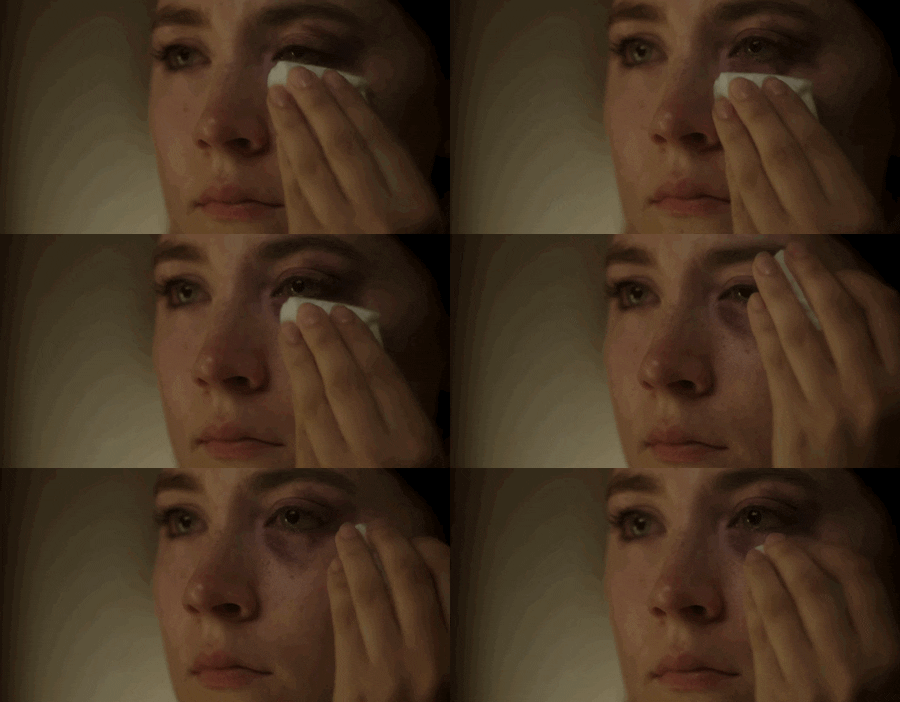
Over the past few years, we've had visible mainstream representation of what domestic violence truly looks like. Perhaps most notably, the movie It Ends With Us tapped in to the nuance of what a violent relationship can look like. Unlike so many other portrayals, which often oversimplify interpersonal violence in relationships, this one showed us shades. In doing that, it helped other women recognize pieces of their own stories.
October is Domestic Violence Awareness Month, and when it comes to awareness around this issue, it isn't enough to just acknowledge that it exists. It's also important that we talk about how it shows up.
I recently worked on an article about former tradwives. I spoke with multiple women who escaped from "traditional" marriages, and they all reported one thing: In each situation, there was abuse...and that abuse absolutely affected their health. All the women I interviewed reported mental health issues (especially postpartum depression) autoimmune diseases, and/or the health effects of social isolation.
I think it's important that we think about domestic violence this way — it's not just a relationship issue, it's a health issue, one that primarily affects women and can quite literally be fatal.
Like so many other women's health issues, women are gaslit when it comes to domestic violence. They're made to feel like they are the crazy ones. When they open up about their experiences, of they hear some version of "are you sure? He seems so great" — which lands a lot like "it's probably just in your head, discomfort is normal", which is something women so often hear in medical settings.
The important of awareness — real, nuanced, honest awareness that digs into all the ways domestic violence can present — can't be overstated. Because it isn't just about bringing awareness to the fact that domestic violence exists, it's about giving women the tools to identify it within their own homes, or even among other people in their life.
Ask Clara:
"How common is interpersonal violence?"
Dancing With the Stars and the Policing of Women's Feelings
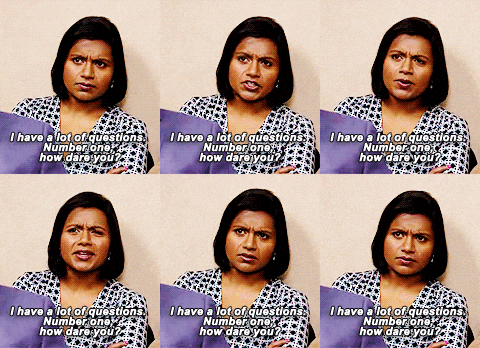
The thing about reality TV? It isn't just entertainment; it's a lens through which we can view human behavior and societal standards. And while Dancing With the Stars isn't what initially comes to mind when most people think "reality show", it absolutely showcases both of these things in so many ways.
Most recently — though certainly not for the first time — it's giving us a look at how uncomfortable people are when women, especially women of color, are anything but merely grateful for whatever crumbs they are handed.
See: Britt Stewart. Stewart has been a professional dancer on Dancing With the Stars for years, and it's been abundantly clear that she routinely gets the short end of the stick. It's worth mentioning that Stewart is the first Black female professional dancer in the show's history.
For those who don't know how Dancing With the Stars works, here's a TL;DR. There are a group of professional dancers who are each paired with one "star" cast member to compete per season. Obviously, young, fit people with dance backgrounds are at a major advantage...but those contestants are typically paired with a small group of pros who are clearly favored by Dancing With the Stars production. Stewart, unsurprisingly, is not among this group.
Stewart has revealed her top two dream partners, and both of these male celebrities have been cast on the show...but neither has been assigned to Stewart. While no professional is entitled to choose their partner, this is obviously a slap in the face to a woman who has been nothing but loyal to the show, and has carried the weight of being the first Black woman to hold a pro spot with incredible grace and dignity. This season, Stewart was eliminated early from the competition, even though she and her partner, Taylor Hanson, were doing a great job. She was, unsurprisingly, disappointed. Visibly so. I imagine it wasn't just this elimination, but a history of being overlooked by both production and audience members on this show.
And now, people have a problem with her visible disappointment. They're calling her "rude" and "ungrateful" and accusing her of "snubbing" other cast members, all because she was about to cry immediately after her elimination.
This isn't the first time someone on Dancing With the Stars has been criticized for not handling harsh criticism or an untimely elimination "well".
When Lauren Jauregui was eliminated way too early from the same competition, she cheekily responded "pissed" when asked how she was feeling. The Internet has some ~big feelings~ about that one.
Simone Biles made headlines for responding with "smiling doesn't win you gold medals" when asked why she didn't smile after her performance. This is not an exhaustive list.
And again, it's not about Dancing With the Stars. This is about the expectation that women never demand more for themselves. It's about the policing of their disappointment when they dare to let it show. It's about how we expect women, especially women of color, to just accept what is giving to them, no matter what.
Ask Clara:
"Why do we police women's feelings?"
We Really Need to Stop Underestimating Menstrual Cramps
It's 1:19 pm on Monday afternoon and I've just settled down for my work day. This is a massive privilege: I am a self-employed, work-from-home mom. I make my own schedule, so as long as I get my work done, starting my workday in the afternoon is possible, though never ideal.
But even now that I've started my workweek, it doesn't look the way it normally does (read: Sitting at my kitchen table and typing away). Instead, I'm on the couch, a cushion on my lap and a heating pad in the waistband of my leggings (the GOAT of leggings has some serious stretch and is my go-to always, but especially on days like today).
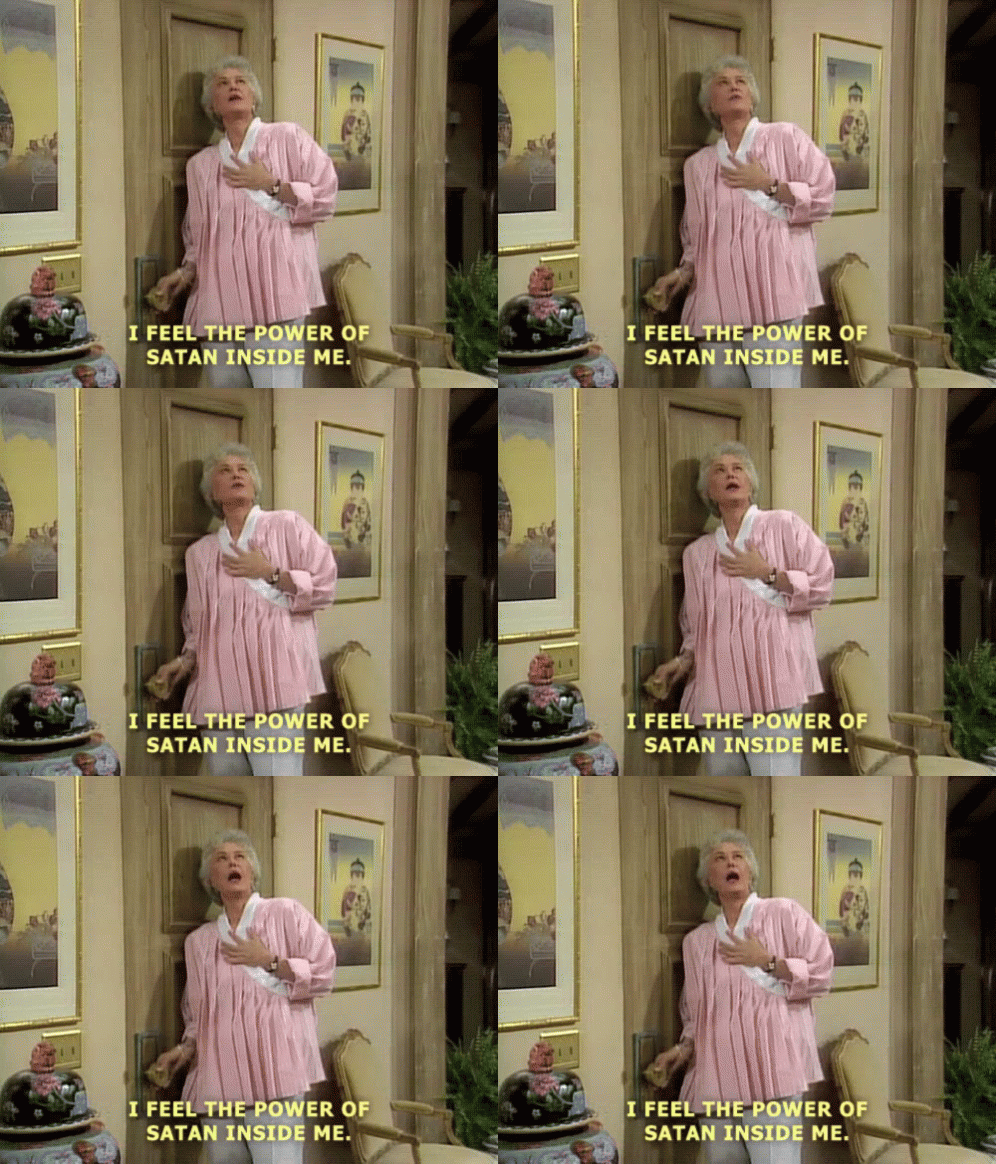
All this is happening because the cramps are cramping...and once again, I'm struck by how debilitating they can be.
Menstrual cramps are never considered a "good enough" reason to miss work, have a work-from-home day, or even cancel on plans with a friend. Somehow, it's okay to say "I can't work today, I have a cold", yet "I can't possibly get dressed, drive myself to work, sit in uncomfortable clothing all day long and perform as though I'm not crippling pain thanks to my menstrual cramps" is considered...not a good enough reason to take it easy? (It's also considered "TMI" which is both a different topic entirely and completely related to this one).
I can power through my day with a runny nose just fine, but when cramps hit hard? All I can really manage is to curl up on the couch with a heating pad and whimper in discomfort. Because this is real pain. And we need to start treating it as such.
Menstrual cramps are often treated like a joke. When we have them, we're told it's "normal", that periods are "supposed" to be uncomfortable. They're viewed as an inevitable inconvenience, not what they can actually feel like: Debilitating pain that can, quite literally, bring you to your knees. That, compared with other period symptoms (fatigue, nausea, and migraines tend to be a few of my ~faves~), makes simply proceeding with life as usual feel pretty much impossible. Yet that's what we're expected to do every 28-ish days.
Again, I'm really privileged. I get to deal with my worst menstrual cramps by having days like today, days when I can't do much more than lounge on the couch in my comfies, snuggling with my heating pad, and working from the couch. We all deserve this. But the fact of the matter is, too many women have no real choice but to just...muscle through. And to do that while not being taken seriously? It's totally unfair, and just another sign of how deeply apathetic our world is when it comes to how women feel in their bodies.
What is Pinkwashing and How Does it Affect Breast Cancer Survivors
It's officially October, which means it's officially Breast Cancer Awareness Month...and you've probably noticed a lot of pink.
Brands are rolling out items in limited-edition pink offerings, or maybe they're launching a whole collection devoted to breast cancer awareness. It's easy to indulge in some shopping, especially if the brands promise to donate a portion of their proceeds to a breast cancer-related cause.
But where does it cross the line from supporting an important women's health cause into pinkwashing?
According to BreastCancer.org: "Pinkwashing is a type of cause marketing — which is a partnership between for-profit businesses and charitable groups — that uses the pink breast cancer awareness ribbon to promote their goods or services."
This doesn't mean that every campaign or product that uses a pink ribbon or the breast cancer awareness label is guilty of pinkwashing. Sometimes the term applies when a brand uses this ribbon while selling a product that might increase a person's risk of breast cancer, for example.
According to a TikTok video from a breast cancer survivor, a lot of companies will add a pink ribbon to a product, yet keep all the profits instead of donating them to causes that benefit those affected by breast cancer.
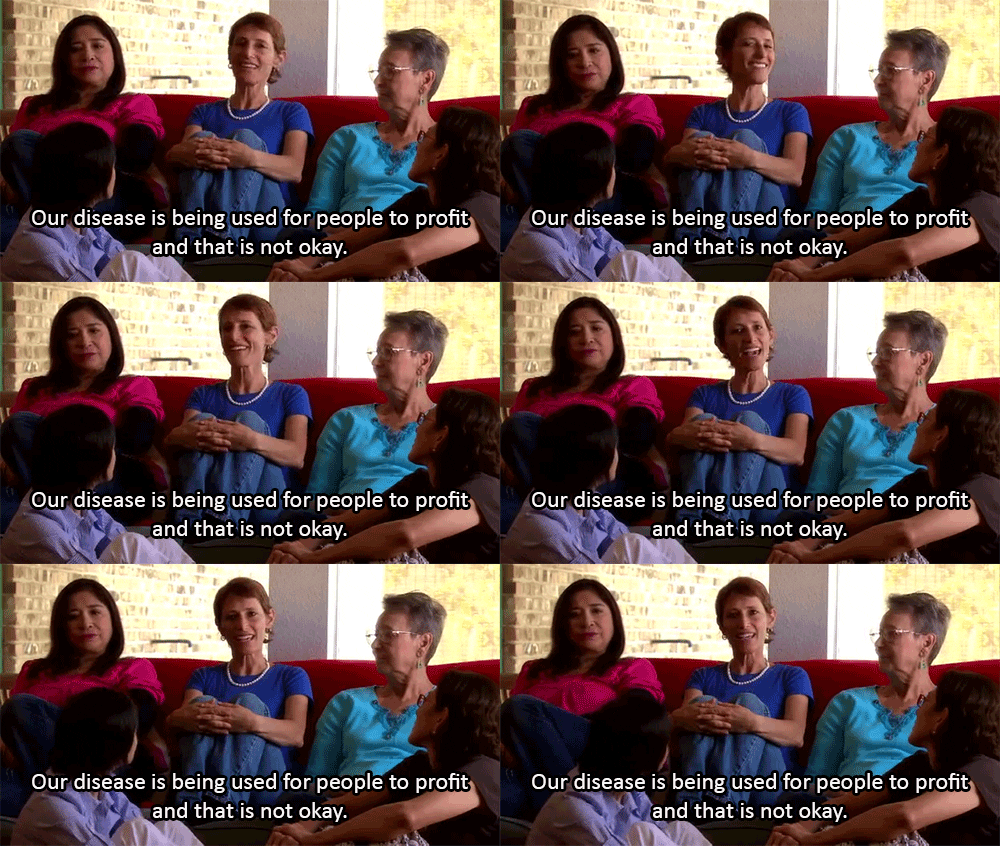
Another creator points out that some companies will claim they're donating a portion of their proceeds, yet won't clarify what percentage. In some cases, the amount they donate is negligible. One brand, for example, is under fire for donating just 2 percent of their proceeds of a capsule collection advertised as a way to give back to benefit the Susan B. Komen foundation.
The complicated thing with pinkwashing? Often it is insidious. It really comes down to a performative approach to supporting people affected by breast cancer rather than a genuine one. And as we all know, there's no clear line between genuine and performative activism.
It raises another question, though: Why is breast cancer one of the only women's health causes that gets this kind of attention? Is it because it's has such clear branding — because creating items in cute pink shades feels so monetizable, almost trendy? It's starting to feel almost...easy to release a pink item or collection, slap the breast cancer label on it, and let the profits roll in.
Why aren't we seeing this volume of awareness-driving campaigns for infertility, or maternal mental health, or endometriosis, or so many of the other issues that affect women? That's not to take away from the importance or the impact of breast cancer awareness. It's just to say that when comes to breast cancer awareness, we need to remember the real mission. It's not just to sell cute pink items: It's to improve women's health outcomes.
Ask Clara:
"How important is breast cancer awareness?"
We Need a More Expansive View of Caregiving, and This Book Provides It
I've read every book Emily Giffin has written. Some I've loved: Her first novel, Something Borrowed, was kind of my gateway from reading young adult novels to reading women's lit and continues to be a comfort read. Others have left me underwhelmed — most notably, the book she released last year, The Summer Pact, though quite honestly, most of her most recent books have been misses for me.
A few months ago, I found myself wondering if maybe I'd outgrown this author. Maybe it was time to skip the new release. I'm glad I didn't.
Giffin's most recent book, Love You More, worked for me. It just did.
Not only was it exactly the kind of easy, sweet read I've been craving, it also provided some important caregiving representation, the kind I believe we've been needing for a while.
I won't spoil the book, but here's a brief synopsis: Billie is a successful doctor living in New York City. One day, shortly after she gets engaged to her equally successful doctor boyfriend, she receives a call from her first love. That call, and the news he shares, changes everything.
Now how does caregiving come into play? Again, I won't spoil it. But I will say this: A few months ago, I launched a podcast called The Millennial Sandwich. It's dedicated to the experience of being in the sandwich generation — caring for kids and aging parents at the same time. Daughterhood, as we often discuss, has barely received any cultural recognition, even though so many people (and especially women) are actively caring for their parents. But here's what I've learned: It isn't just daughterhood that has gone unrecognized; it's caregiving in general.
People are caring for kids. They're caring for parents. Some are caring for siblings, aunts/uncles, neighbors, friends, spouses...the list goes on. And this book reflects that: It shows caregiving for what it truly is: A life-shifting set of choices big and small. Choices that can feel disruptive or set you on a whole new path. Choices that can make you reevaluate everything or change your priorities.
This book shows that. It's the kind of representation we need, and if you like stories about women reevaluating everything, I think you'll like this one.
Ask Clara:
"What is caregiver burnout?"
"Protect Your Daughters" Has Never Been Enough. Why Aren't We Talking More About Educating Our Sons?
For the past few days, I have been absolutely sickened by what happened at Cornell University. I won't go into the details here, but if you haven't read the news, please read it (and prepare yourself to feel absolutely gutted, infuriated and physically ill).
This is a story about so many things. Violence. Lack of consent. Accountability. Injustice. Dehumanization. Bodily autonomy being stripped, forcibly and violently, from one women...and a sign that it isn't afforded to women in general. So many other things.
But mostly, I think, it's about how deeply all our systems have failed women. Our medical system. Our justice system. Our educational system. Our social system. It's everywhere, and it starts at the very beginning.
I'm the mom of a boy and girl, and I always hear that it's so much harder, so much heavier a responsibility to raise a young girl. To protect a young girl. And yes, I worry about my daughter and her safety every single day.
But protecting out daughters is not enough. It has never been enough.
It's time to change the script: It's not just about protecting our daughters, it's about creating a world in which our daughters aren't so vulnerable. How do we that? By making sure our boys grow up to view women as human beings. It all starts with that.
It's about raising boys who understand the essential nature of consent. Who don't just know it's wrong to ever, ever do anything to a woman's body without this consent, but who also feel called to step up, to not sit idly by while other men violate it.
This is a big, big responsibility — the kind of responsibility that can quite literally change the world if we get it right. And if you play any role in raising a boy, it's your responsibility to carry.
Ask Clara:
"What's the importance of believing women?"
Has Taylor Swift Entered Her Ragebait Era?
Before I say what I'm about to say, hear this: I am a Swiftie to the core. And when my girl released The Life of a Showgirl: The Encore, a four-track extension of her most recent album, I listened immediately.
And like most Taylor Swift fans, I felt...I don't know, surprised? Underwhelmed, maybe? by my first listen, especially when I heard the song "Cleveland!", which has been a major, major topic of conversation online.
I was expecting a deep, beautiful love song about Swift's new husband, Travis Kelce (who, yes, is from Cleveland). Instead we got a song that seemed more about putting the critics in their place.
"Now I'm wearing white/So hate all you like/This is the love of my life," she sings on the track. The other three songs feel a bit more substantial, more adult...but of course, this one is the one that's getting the most attention. Which is...kind of telling? Kind of a sign of where we are and what we pay attention to? Kind of the whole point of what I'm trying to say here?
This song in particular, which seems to be the only one that's overtly about Kelce, is inspiring people on the Internet to speculate that being happy, in love, and in a secure relationship has robbed Swift of her artistry. Personally, I think that take is a little reductive — it's giving a bit of "you can either be a happy woman or a smart woman".
But here's what I will say: Taylor Swift's new music only feels surprisingly shallow because we're stacking her up against...well, herself. And maybe that has less to do with the woman who is, arguably, the best songwriter of our generation losing her magic touch and more to do with what media messaging in general looks like right now (because let's not forget — music is media too).
Swift's new songs, especially "Cleveland!" reminds me a bit of the musical equivalent of ragebait content. It feels quick, reactive, and defensive. My first thought when I heard it was "why does she think so many people are coming for her when in reality she's one of the most beloved, iconic stars in the entire world?"
But at the end of the day, isn't that what we all do? We let the critical hot takes get under our skin. We let them become our inner voice. We, to some degree, are responsible for the ragebait-y world of media because we reward it with our attention. And then the vicious cycle begins, over and over again.
Ask Clara:
"What is ragebait content?"