


Zara Hanawalt
Stop whispering, start talking: sharp, sassy takes on life in a female body.
Does Every Woman Have a Love/Hate Relationship With Her Jeans or is it Just Me?
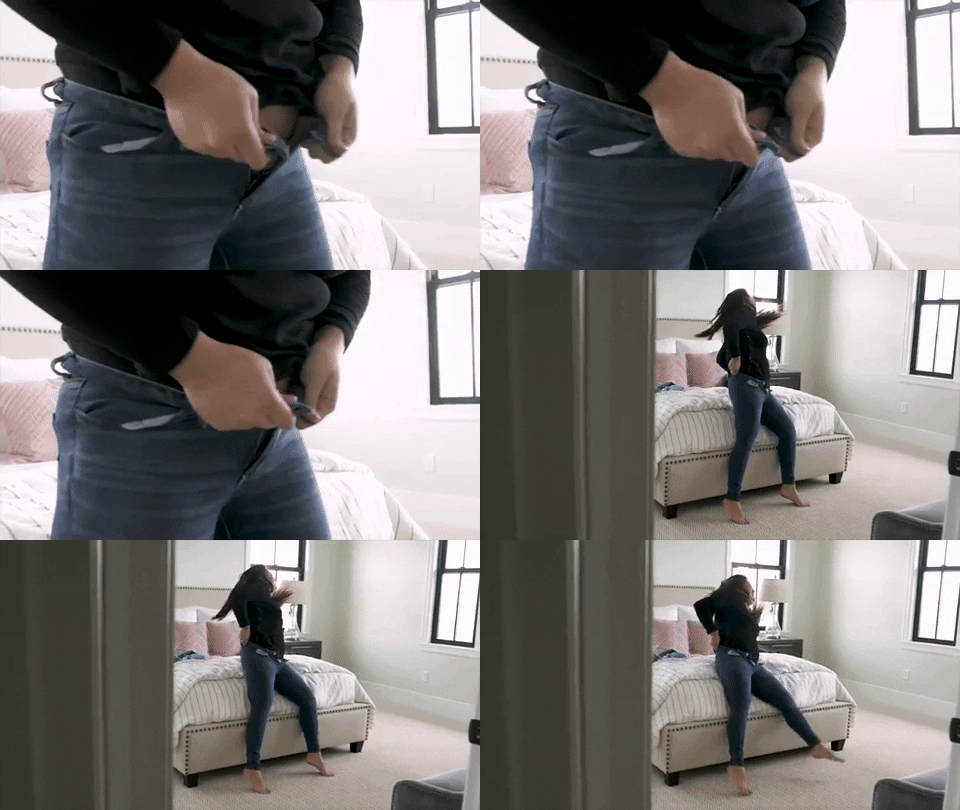
There are few things as satisfying as coming home and immediately taking off your jeans. We can (pretty much) all agree on that, right? That switch from denim to sweats? It's heavenly.
Recently, someone shared with me that she actually doesn't do this — she lounges around her house in jeans all the time. Like...she'll watch TV with a pair of hard pants on. This got me thinking: Are there people out there who actually find jeans...comfortable?
Personally, I would always take sweats, leggings, or even a breezy dress over jeans in terms of pure comfort. But now I'm wondering: Is this just a me thing? Is it a sign that I care more about the size on the tag than I do about how I feel in my clothing? And if that's true...am I going against everything I advocate for right here on this very column?
I guess I always assumed that jeans were just one of those things that everyone had a bit of a love/hate relationship with. We like the way they look, the structure they give an outfit, but not the way they feel. Maybe, despite one woman's assertion that she finds denim pants comfortable enough to lounge in (diabolical, IMO), everyone finds jeans low-key uncomfortable.
But if that's still true, I've got to ask: Were jeans just not built for women's bodies? Have we been forcing ourselves into this item of clothing that was never built with our proportions in mind, only to be told they were an standard, an essential, a wardrobe staple?
Because let's face it, jeans often fall into one of two categories: They either fit you great visually, yet squeeze when you sit down, restrict your movement, and generally make you feel like you can't fully relax...or they feel relatively comfortable, but bag out and just don't look as...ugh, okay fine I'm going to say the word: Flattering.
Listen, if you've stuck with me this long, thank you. I don't know why I'm doing all this about whether jeans are comfortable or not, but bare with me. There's a point i'm trying to make. At least I think there is.
And that point? It's the jeans, like so many other things, weren't mean with women's bodies and needs and comfort in mind. We've been conditioned to think we are the problem, but maybe the problem is that an item of clothing with so much structure, where fit is of the essence, ought to executed with a real understanding of how a woman's body is shaped...and let's face it: Women's bodies are far more complex, more nuanced. I've never heard a man say jeans are uncomfortable, or that they feel too tight in certain places and too loose in others, or that they gap in the waist or don't fit right on their bloated days, for example.
Jeans, the way they're made, the way they look vs the way they feel, the way we've been conditioned to prioritize the former over the latter when we shop for them...it all means something.
Ask Clara:

"Do most women have body image issues?"

The Double Standards of Parenting and Domestic Labor are so Real
As a journalist who covers women's health and parenting, I am very, very well aware of how deeply rooted the double standards between men and women in our society are. They're everywhere, of course, from the dating world to the workforce and beyond. Today, I'm reflecting on how they show up in the home,
But first, a little background: My husband travels pretty frequently for work, which means I hold it down at home while he's gone. I take care of our two kids, I cook meals, I clean up, I make lunches, I facilitate homework, I maintain the activity schedule, and I continue working on my career while he's gone. And I do it largely alone (for context, my kids are in elementary school). I'm not saying this to boast about how I ~do it all~ (I don't!); it's just the reality of our situation.
This week, I had planned to leave town to be there for my family during an emergency. Before I left, the requests to help my husband started pouring in: People were offering up meals, rides for our kids, babysitting, and more. I even had multiple relatives offer to fly across the country to come help care for our kids.
Do I appreciate all the offers of support? Absolutely! We are blessed to have people who want to help prop up my family during hard times.
But I also can't help but notice how different the reactions are when I am the one at home holding down the fort. When I parent alone for days at a time, nobody seems to wonder how the meals will get cooked, or how the kids will get where they need to be, or how I'll manage to care for them while working. Yet when my husband — a very, very capable father (who honestly might be better than I am in the kitchen these days) — is left to manage things at home? People seem to suddenly feel it's too much to take on.
My point here isn't that we should support men less, or stop offering to help families through challenging times. It's that we ought to think about how different the expectations are of women, and how much women are expected to do without offers of support or help.
The Double Standards of Parenting and Domestic Labor are so Real
As a journalist who covers women's health and parenting, I am very, very well aware of how deeply rooted the double standards between men and women in our society are. They're everywhere, of course, from the dating world to the workforce and beyond. Today, I'm reflecting on how they show up in the home,
But first, a little background: My husband travels pretty frequently for work, which means I hold it down at home while he's gone. I take care of our two kids, I cook meals, I clean up, I make lunches, I facilitate homework, I maintain the activity schedule, and I continue working on my career while he's gone. And I do it largely alone (for context, my kids are in elementary school). I'm not saying this to boast about how I ~do it all~ (I don't!); it's just the reality of our situation.
This week, I had planned to leave town to be there for my family during an emergency. Before I left, the requests to help my husband started pouring in: People were offering up meals, rides for our kids, babysitting, and more. I even had multiple relatives offer to fly across the country to come help care for our kids.
Do I appreciate all the offers of support? Absolutely! We are blessed to have people who want to help prop up my family during hard times.
But I also can't help but notice how different the reactions are when I am the one at home holding down the fort. When I parent alone for days at a time, nobody seems to wonder how the meals will get cooked, or how the kids will get where they need to be, or how I'll manage to care for them while working. Yet when my husband — a very, very capable father (who honestly might be better than I am in the kitchen these days) — is left to manage things at home? People seem to suddenly feel it's too much to take on.
My point here isn't that we should support men less, or stop offering to help families through challenging times. It's that we ought to think about how different the expectations are of women, and how much women are expected to do without offers of support or help.
Who Even Has Time to Grieve?
Earlier this week, my family experienced a major loss. The kind of loss that shifts everything. The kind that makes you realize that even the best laid plans are subject to change. The kind that makes you look at the past, the present, and the future differently. The kind that makes you realize life is too damn short.
But experiencing in a loss in 2026 — especially when you're a mom and card-carrying member of the sandwich generation who also happens to be juggling a career and many other responsibilities — doesn't just put into perspective how short life is. It also makes you realize how cluttered it is.
Over the past few days, I've been trying to find corners of time for my grief...and I'm weighing how much I can put off right now, and how much I have no choice but to tackle immediately.
Feeding my kids? Something that can't wait.
Emailing their teachers to let them know they may seem off in the next few days? Something that can't wait.
Making travel plans, which includes coordinating an emergency passport renewal and a Visa? Something that can't wait.
Finalizing some commitments I've made to to my kids' school? Things that can't wait, but can be delegated.
My work? Some if it can wait, but even for those things that can be put off, there are things that need to be set in place and people who need to be notified. When you're self-employed, it's not as simple as taking some PTO.
It's not just me. So many of us are experiencing this...and feeling like grief is something we have to schedule, rather than just...sit in. We can't control life, yet we're operating in a system that tells us we need to have everything under control. Speaking of that system, it's eye-opening to see how much of it doesn't account for the fact that sometimes, life is just...life-ing.
I am traveling to go be with my extended family, but my kids can't come with me; they're only allowed to miss a certain number of school days each year. I don't have to take PTO for my job, but most people do...and that doesn't account for the fact that life's emergencies don't always fit neatly into an allotted amount of time. And then there's all the other stuff: The need to go over my kids' schedule with my husband before leaving town. The need to coordinate his schedule so he can solo parent while I am gone. The need to field calls and texts and answer questions and respond to everything. It's a lot. And since this is the loss of an extended family member, not an immediate family member, I'm not even the one making the most crucial calls or feeling the most intense grief.
This whole experience is making me question why we are expected to live this way...and how hard it is to realize that many us can't even afford to grieve.
Ask Clara:
"How does grief show up in day-to-day life?"
Why Everyone is so Mad About Sydney Sweeney's Newest Ad
Last year, women's sports really had a moment. We all suddenly realized we hadn't been paying enough attention (and that the systems that pay athletes hadn't been paying nearly enough money) to female athletes and their athletic achievements and events. Thanks to this shift, people finally began to take women in sports more seriously.
Unfortunately, a new Sydney Sweeney ad is moving things in the wrong direction. The ad, which is for sports predicting market Novig, is hyper sexualized, to say the least. In it, Sweeney poses nude and covers her body with various sports equipment (think basketballs and football pads). She makes a few comments about how this service is all about "sports"...and so many people, especially women, have been rubbed the wrong way by this.
Women have historically struggled to be taken seriously in the world of sports — not just professional athletes, but all the way down to young girls who play at school or in rec leagues. Why does Sweeney's ad take us in the wrong direction? Because it leans into the idea that the value of women's bodies lies in the way they look, not in what they can do. Juxtaposed by the sports equipment used as props to add to the male gaze-i-ness of the images, this just feeds into that narrative.
Female athletes are sharing why this feels personally insulting. For example: One woman pointed that even now, when she mentions that she's a gymnast, people's first response is often "oh, so you're flexible?" in a suggestive way.
Listen, this doesn't all fall on Sydney Sweeney — though, let's not forget...she has a history of starring in ads that miss the mark. Obviously, there's a team behind the scenes that came up with the concept for the sake of shock factor and, again, fulfillment of the male gaze. But let's not pretend she isn't complicit here.
Some argue that we applaud some women for owning their sexuality and choosing to pose nude, and yeah. It's a fine line between what lands correctly and what simply doesn't.
Here's the thing: Sweeney's ad isn't just about the skin she shows or the suggestiveness of her poses. It's about the larger concept...and the way it disregards all the progress female athletes have made.
Ask Clara:
"What barriers do female athletes face?"
The Wellness Industry is Booming. Why Are We Surprised?

I recently came across a brilliant post on Instagram. In it, creator Jess Britvich calls out wellness influencers for constantly fearmongering about "big pharma", all while selling their audiences both ideas and products as alternative solutions.
She's right: Influencers and wellness brands make money — lots of money — by exploiting the rising fear and distrust people feel towards medical institutions. But here's my hot take: A huge part of why they're able to exploit that distrust is because that distrust is already well-established.
So many of the people who distrust medical institutions don't do so because wellness influencers convinced them to. They distrust medical institutions because they've felt failed by them. They've experienced medical gaslighting. They've been taken advantage of by a broken system. They've been ignored, dismissed, and more...and so they turn to the places where guidance doesn't come with a co-pay or a long wait or a healthcare provider who rushes through an appointment. They turn to the internet.
And on the internet, information — or, more often, misinformation — is everywhere. The thing is, even for someone with a solid base of knowledge, it can be impossible to untangle the two. A wellness influencer may rave about a product that worked for them, and you may ask a qualified professional about the validity of said product...and that professional may tell you there's no evidence to support the effectiveness. and while that's true, a lack of current evidence doesn't mean it won't or can't work.
This gap — the space between or need for solutions and answers and the availability of those answers and our own access to information — that's where wellness BS thrives. And clearly, it's a gap large enough to fit an entire industry worth billions.
So what are we supposed to do? It's complicated.
I think we need to start by understanding that health and wellness are different things. We need to remember that even when medical experts feel inaccessible, they still hold more knowledge than a wellness influencer. We ought to always keep in mind that if a provider is making us feel unheard, gaslit, or dismissed, it doesn't mean every other professional will do the same. We can always find a new doctor.
And we can apply a level of discernment to the things we see online. Sure, there may be no evidence to support the effectiveness of something that works really well for us on a lifestyle level (like this little guy? a gamechanger for my migraines). Ultimately, though, we're better off seeking out credible answers and solutions rather than believing everything we see online.
What Does it Actually Mean to be a Good Wife?
Somehow, I found myself on the side of TikTok that features "high-effort wife" content. Here, women proudly go above and beyond for their husbands. Think: Waking up at 4 am to make and pack their lunch. Laying out their clothes every morning. Making all the appointments so their partners don't have to think about it. Handling all the cleaning, cooking, household shopping.
To this, a few creators have responded to say it's "weird" that these women are treating their husbands like...well, children. And those creators? Well, they're being eviscerated. Others online are calling them bad wives, questioning if they even like their husbands.
But here's my take: Why are we so quick to question whether a wife actually likes her husband, and so hesitant to question whether a husband actually likes, respects, and cares for his wife?
If you want to pack your partner a lunch or go above and beyond, I think that's great. I love doing things for my partner too! But here's what I want to call out: Why do we think women need to exhaust themselves in order to be considered "good" to the people in their lives? Waking up in the wee hours of the morning just so you can pack a lunch, for example? Handling all the chores at home? That sounds exhausting.
I asked my own husband if he would even like it if I woke up to make him breakfast and/or lunch on the days he wakes up super early to travel for work, and just as I expected, he said no. He would rather I stay asleep and be well rested.
Now listen. I'm not a morning person, so that's why I won't be doing some of the specific "high-effort" stuff these ladies are calling out. Maybe some of them are actually awake super early and genuinely want to do this stuff. I don't know.
What I'm more concerned with is the policing of what makes someone a "good wife". Just like the "good mother" ideal, it needs to be unpacked. Because contrary to what these narratives suggest, there are so many ways to be "high effort" as a partner, good to your spouse, and a loving wife that don't involve performing constant domestic labor....and literally losing sleep to do so.
Ask Clara:
"Do women take on more household labor?"
The Forgotten Piece of Gloria Steinem's Feminism
Last week, Gloria Steinem, feminist icon, died at 92. It's yet another crushing loss of 2026.
In the wake of Steinem's death, social media has lit up with tributes to her legacy. But here's a piece of that legacy we often neglect to honor: Steinem's version of feminism has always included respect for care work, and an insistence that the rest of the world finally sit up and take notice of the social and economic value of this work.
On social media, there's a real distortion of what feminism truly is. Many say they aren't feminists because they don't want to work; they "just" want to be moms. My take? Focusing on motherhood doesn't make you any less of a feminist. What does, in my view, make you less of one? Playing into the constant cultural and systemic devaluation of care work — the work women have historically shouldered.
Steinem never had children of her own, yet she understood how essential it is to support mothers. Because ultimately, it's not just about motherhood: It's about caregiving. Caregivers in the United States are routinely under-supported. We lack paid leave, affordable childcare (and accessible elder care), economic value assigned to care work (yes, it is work), and cultural recognition of caregiving. Many people view feminism as anti-family, when in reality, causes that support caregivers are inherently feminist because they help women most of all.
Gloria Steinem, the obvious face of the feminist movement, often hailed as the mother of feminism, is proof of this. We often forget this part of her legacy, but she routinely championed caregivers. She partnered with maternal activism organizations. She spoke, loudly and openly, about the need for economic recognition of care work. She lived the caregiver experience as a caregiver to her mother...and she paid it forward. She worked to create a version of feminism that honored family life, not lured people away from it, as some like to suggest.
To truly honor her legacy, we must remember this.
Ask Clara:
"What is the economic value of caregiving?"
Miss Uganda Brings C-Section Awareness to the Runway
If you're a C-section mom, chances are you've heard that you "took the easy way out" or that you "didn't actually give birth".
I don't know if this happens so often because people feel the need to weigh in on every single thing a woman does with her body...or because people fundamentally misunderstand what a C-section actually entails. Probably some of both.
But now, a major fashion moment has entered the building to give the world a real look at what C-section actually is and what it truly does to your body. And it's about time.
Muhoza Trivia Elle, who is Miss World Uganda 2025, walked the runway in a gown by KEESHA, a modest couture brand by Keesha Abdallah. The gown is called "The Layers of Life" and represents the layers that must be cut through during a C-section. The dress has a gorgeous silhouette and vibrant color palette (you can see the photos here), but it's more than meets the eye.
The colors represent the seven surgical layers of C-section childbirth: Skin, fat, peritoneum, fascia, abs, uterus, and amniotic sac. I love this artful C-section representation.
Somehow, even though I've been through this type of birth, I've never fully wrapped my head around what a physical ordeal it truly is. This type of representation matters: It shows women what they've done. It challenges the idea that this is "an easy way out of giving birth the real way". And it shies away from depicting this type of birth as ugly, undesirable, or a last resort.
For so long, we've been told that the details of how women give birth are "gross". Part of why nobody really knows how a C-section actually works is because of this. This type of creation challenges all that in the most beautiful, artful way.
Ask Clara:
"What happens during a C-section delivery?"
Ms Rachel & the Power of the Midlife Pivot

At 38 years old, I often find myself falling into this "it's too late" trap.
It's too late to have a third baby. It's too late to go back to grad school (again). It's too late to pivot in my career.
But it's not too late: As we enter this phase, millennial women are rewriting the rules of midlife. See: Ms Rachel, the musician who built a whole empire around connecting with kids, who recently put it into perspective.
A woman (@bwhite_) posed a question on threads: "Y’all think 35 is too late to consider changing careers completely ?". Ms Rachel had the best response. "I had the idea for Ms Rachel at 36 years old", she replied.
It's such a powerful reminder: We can use the tools we've gained in new ways — or we can build a new toolbox completely — at any age. We hear the reassurances, of course, but nothing really shows us it's possible like a real life example. And here, Ms Rachel is giving us one: She came up with an idea at an age at which so many women are told it's "too late". That idea blew up.
Not everyone will be Ms Rachel, of course. We can't all be moguls, but we can pivot and change our minds and start new things and learn new skills. Those things don't stop being true when we exit our 20s, contrary to what so many narratives suggest.
I think so many of us have always felt that men were given endless permission to try new things, to start new companies, to change lanes or occupy multiple lanes at once. Women, on the other hand, were always encouraged to stay small.
But as people begin to live longer, technology changes the career game, new industries pop up, portfolio careers become more and more popular, and more lead by example, we have the opportunity to make these midlife pivots. And you know what? That's pretty awesome.
Ask Clara:
"What does midlife feel like for women?"