Sponsored by BetterHelp
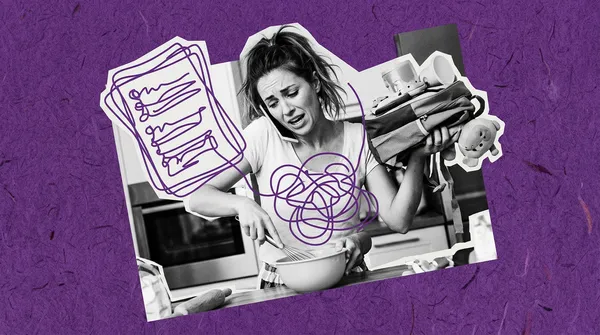
Your 12-year-old has a meltdown at 10 p.m. about a group project due tomorrow that they "forgot" to mention. While scrambling to help, your brain runs through tomorrow's logistics: the dentist appointment, the permission slip, the snacks you're out of, the ride home.
You thought the mental load of motherhood would ease up after the diaper stage. Or, surely, once your kids could pour their own cereal and tie their own shoes?
Spoiler: It's still there. Still invisible, still unpaid, still mostly yours.
What is mental load? (And why it gets heavier as they get older)
Mental load is the cognitive and emotional labor of managing everyone's lives: the remembering, planning, worrying, anticipating, and coordinating that keep a household running.
When your kids were little, the labor was more physical: carrying, lifting, feeding, changing, not sleeping. Now? It's shifted into a different form that's draining your brain power and patience.
You're tracking five different schedules, managing school portals, mediating sibling wars, and planning meals nobody will eat.
The mental load women carry (by the numbers)
According to 2026 survey data from 2,309 Italian mothers with one child published in Frontiers in Psychology, moms report doing more mental labor and invisible tasks compared to their partners.
A 2026 Pew Research Center survey looked at the experiences of 2,242 U.S.-based working parents. It found that 62% of moms with full-time jobs find it hard to balance work and family, compared to 47% of dads.
A 2025 survey conducted by the University of Bath evaluated 2,133 partnered, heterosexual parents in the U.S. It found that moms carry 67% more items on their mental to-do lists than dads (13.7 tasks vs. 8.2 tasks, respectively, at any given time).
The "default parent" role can be exhausting, to say the least. Even when your partner "helps," you're still the project manager.
What the mental load actually looks like now
It's not just remembering soccer practice. It's knowing when registration opens, which kid needs new cleats, who can carpool, who's on snack duty, and that your daughter is anxious about the coach. "One" task is actually an ecosystem of multiple other tasks — many that depend upon each other, and all that depend upon your memory.
But it's not just reserved for tasks and checklists. You're managing everyone's emotional weather systems while losing track of your own. Holding your tongue when your teen snaps at you, even though you just spent 20 minutes fixing their scheduling conflict. Knowing every teacher's name, every friend's drama, every upcoming deadline — while your partner asks, "Wait, when are parent-teacher conferences?"
Now, the 3 a.m. wake-ups aren't from a crying baby but from your brain running through the week's logistics and temperaments of everyone in the home. Those late-night feeds may not seem so bad in hindsight.
The invisible labor of mothers: what it does to you over time
Here's the part nobody talks about enough: The mental load isn't just exhausting in the moment. Over time, it erodes you.
Your nervous system never fully rests because you're always scanning for the next need, the next problem, the next thing that'll fall apart if you're not paying attention.
Then there's the loss of mental space for yourself. When was the last time you had a thought that wasn't about someone else? When your brain was genuinely quiet, not running through a checklist?
There's an evolutionary root to this, especially for mothers who carried their own pregnancy: you've always been attuned to your baby's needs, from day one. Your schedule, food intake, and priorities have always come second. The only difference is now, their heart is beating outside your body — and often comes attached to a strong-willed mind of its own.
Resentment builds quietly, year after year. This leaves you sitting with the question (or bringing it to therapy): What does it mean for your sense of self when your entire cognitive bandwidth is occupied by other people?
The identity shift nobody warned you about
Your kids can now shower, make a sandwich, and maybe even get themselves to school. But the mental load hasn't decreased — it's just become more invisible.
This is one of the themes explored in episode 2 of BetterHelp's Motherhood With You series: the loneliness of doing all this invisible work for people who are actively pulling away from you. They don't want to tell you about their day anymore, but you're still the one who has to know everything.
At this stage, you might wonder whether you're supporting your kids or enabling them to be less independent. Your relationship with your spouse or partner might be taking a backseat to your role as mom. Then there's feeling guilty for wanting alone time.
You can only take so much before wanting to explode or shut down, and that's where your partner's support comes in.
How to explain mental load to your husband (without losing it)
Start outside of a crisis moment — not when the house is in chaos, and you're already at your limit.
Instead of "You never help," try: "I'm feeling mentally crowded and want to talk about how we're managing everything."
Concrete examples work better than abstract explanations. Something like: "I'm the one who knows picture day is Thursday, that he needs a blue shirt, and that I need to order it by Tuesday to get it in time. That's four steps of invisible work before anyone's dressed."
Questions Women Are Asking
The project manager analogy might land. Explain how you're doing all the anticipating, planning, delegating, and following up, without the salary or recognition.
Remember, though, this isn't about blame. It's about visibility.
One practical framework worth looking into? Eve Rodsky's Fair Play method. The card-based system makes invisible work visible by identifying roughly 100 common household tasks (everything from donating outgrown clothes to getting the mail) and dividing them so that one person fully owns each task from start to finish — not just the execution part.
Why "Just tell me what to do" doesn't work
This well-intentioned response misses the point entirely. It puts the mental load of delegating on you, too. Managing is a job.
This is the core insight behind Fair Play: Whoever owns a task needs to conceive it, plan it, and execute it. Do not just do the last step when asked.
Don't be afraid to communicate feedback: "I appreciate that you asked if you need to bring the trash out tonight. In the future, it would be more helpful if you looked at the town schedule hanging on the fridge."
Carrying the mental load: What actually helps
Immediate survival tactics:
Write it down. Get it out of your head and into a shared calendar, an app, a whiteboard on the fridge — anything that externalizes the logistics.
Say "no" to one thing this week. You don't need to explain why.
Stop doing the emotional labor of protecting everyone from your overwhelm. You're allowed to say, "I'm tapped out right now." In fact, it's healthy for your children to see these kinds of boundaries.
Longer-term shifts:
Redefine what "shared" actually means. Not "He helps when I ask," but "We both hold responsibility."
Let some things drop. Hard but necessary. Your kid will survive a forgotten snack. They won't learn if there aren't any lessons.
Reclaim mental space. Ask yourself, What do you want to think about?
Therapy. Not to become a more efficient family manager, but to process what carrying this load has done to your sense of self. Resentment will eat you from the inside out, but therapy is a safe place to let it out and examine it more closely.


Therapy for burnout and mental load
Therapy addresses things self-help can't quite reach:
Grieving who you were before becoming the family manager
Processing years of built-up resentment
Reclaiming an identity that exists outside everyone else's needs
Unlearning of unrealistic expectations that you, or someone else, or society placed on you as a mom
BetterHelp offers an accessible option for moms who don't have time for traditional therapy. The irony of needing help but not having the bandwidth to get it is something every overwhelmed mother understands.
The invisible mental load isn't sustainable (and you don't have to carry it alone)
You didn't sign up to be the sole household manager when you became a mom. The responsibility just landed on you, and it kept accumulating. The system is broken, not you.
Getting help isn't selfish. It's necessary.
Your kids will be fine if you stop anticipating every need. You won't be fine if you keep going like this. That's not a dramatic statement. It's just the truth that every mom carrying the invisible load already knows in her bones.
There's no shame in getting support. Get started with BetterHelp.