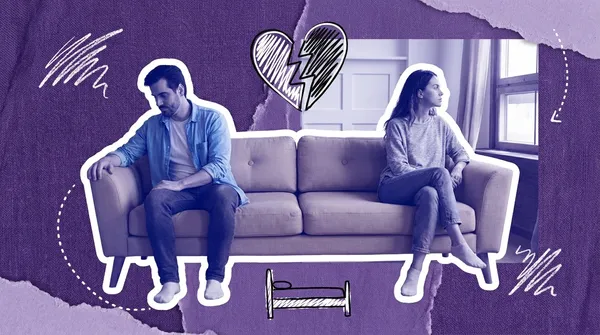
You used to fall asleep tangled up in each other. Now you're on opposite sides of the bed, phones in hand, barely touching. Maybe it's been weeks. Maybe months. Maybe you've genuinely lost track of the last time you were intimate, and that realization sits heavy on your heart, leading to feelings of guilt, confusion, and even grief.
So what happens when sex in a marriage just… stops?
What is considered a sexless marriage?
Researchers usually draw the line at fewer than 10 sexual encounters a year — a number that comes from the General Social Survey, one of the longest-running studies of American life. But that number is pretty arbitrary. A couple having sex nine times a year isn't meaningfully different from one having sex eleven. What actually matters isn't the number; it's whether both partners feel okay with where things stand.
So is sex once a month a sexless marriage? Technically, twelve times a year clears the threshold. But if one partner wants it weekly and the other is fine with monthly, that mismatch can feel just as painful as no sex at all. The gap between what each person wants is often the real issue, not whatever number's sitting in a notes app.
And this isn't exclusively a married-people problem. Long-term couples of any kind (unmarried, cohabiting, engaged) run into the same patterns.
Estimates of how common this is vary depending on how researchers define and measure it, but they consistently land in a similar range. A 2017 analysis published in Archives of Sexual Behavior, based on GSS data from more than 17,000 American adults, found that roughly 1 in 7 men and 1 in 4 women reported no sexual activity at all in the previous year. Factor in couples having sex only a handful of times a year, and the share of marriages that qualify as sexless or nearly sexless climbs to somewhere around 14-15%. That's millions of couples navigating this right now. If this is your situation, you're not alone, or even unusual.
Why does this happen? (It's rarely just one thing)
There's rarely a single clean explanation. Most of the time, several factors layer on top of each other until sex just slowly falls off the list.
Mismatched libidos. Desire naturally shifts over time. The person who initiated constantly in year one may not be that same person in year seven, and that's normal, not a sign of failure.
Stress and mental load. According to a 2026 Rescripted survey of over 300 women, exhaustion and mental load were the single biggest factor behind a slowed or stopped sex life, cited by nearly 30% of respondents. It's hard to feel desire when you're running on fumes.
Hormonal changes. Perimenopause, postpartum shifts, thyroid conditions, PMOS — all of these can directly suppress libido and alter how sex feels physically. Among women ages 25-34 in the same Rescripted survey, 14% pointed to hormonal changes as the primary driver.
Relationship disconnection. Unresolved resentment, poor communication, and emotional distance can all erode the foundation that desire needs to exist.
Pain and medication side effects. Endometriosis, vulvodynia, chronic illness, SSRIs, and hormonal birth control can make sex uncomfortable or strip away desire entirely.
Body image. Feeling disconnected from or dissatisfied with your body can make it incredibly hard to be vulnerable with another person.
Many women in the Rescripted survey (11.3%) selected "it's complicated — a few things are tangled together," which may be the most honest answer of all.
Menopause and sexless marriage: the hormonal truth nobody talks about
Declining estrogen during perimenopause and menopause can hugely impact libido, vaginal lubrication, and the comfort of sex itself. Vaginal tissue becomes thinner and less elastic. Natural lubrication decreases. Sex that used to feel good can start to feel painful, and pain is one of the fastest ways to shut down desire entirely.
This is physiology, not a reflection of how much someone loves their partner. A woman whose body is producing less estrogen isn't choosing to want less sex; her hormonal environment has fundamentally changed.
Solutions exist, and they're more accessible than many women realize:
Vaginal moisturizers and lubricants: Bonafide Revaree (a hyaluronic acid suppository), Replens (one of the most widely available and clinically studied long-acting moisturizers), Good Clean Love BioNude (a natural option), and Hyalo Gyn (another solid hyaluronic acid gel) are all worth exploring.
Prescription vaginal estrogen: Options like Estrace, Imvexxy, and Vagifem deliver localized estrogen directly to vaginal tissue. These are worth discussing with a provider, especially for women experiencing significant vaginal dryness or discomfort.
Hormone therapy: Systemic hormone therapy can address libido, hot flashes, and other menopausal symptoms. A provider familiar with menopause management can help weigh the risks and benefits.
Pelvic floor physical therapy: Underutilized and genuinely effective for pain during sex, especially when vaginal tissue changes contribute to muscle tension. Understanding what the pelvic floor is and why it matters is a good place to start.
How a sexless marriage affects both partners
A lot of the conversation around sexless marriages frames this as something that happens to one partner — usually the one with stronger desire — but reality is more layered than that.
The higher-desire partner often feels rejected, undesirable, and emotionally disconnected. The lower-desire partner often feels pressured, guilty, and ashamed, like their body or their feelings are the problem. Both experiences are valid, and both hurt.
Over time, unaddressed sexual disconnect can take a toll on intimacy in ways that extend far beyond the bedroom. Communication breaks down. Emotional distance grows. Small resentments calcify into something harder to reach. Partners may stop touching altogether, not just sexually but casually: no hand on the small of the back, no spontaneous hug in the kitchen.
That doesn’t mean a sexless marriage is automatically a doomed one, but it is worth addressing, because the longer the gap grows, the harder it can feel to bridge.
Real solutions: how to fix a sexless marriage
There's no single fix here. The right approach depends entirely on what's driving the disconnect, and it may take a combination of strategies to make real progress.
Start with the conversation (the one you've been avoiding)
Questions Women Are Asking
"I miss feeling close to you" lands differently than "you never want sex." The first is an invitation, the second is an accusation.
Timing matters. Don't have this conversation right before bed (when the pressure to perform is highest), during an argument, or while multitasking. Choose a calm, private moment when neither person is depleted.
This conversation will feel awkward, and that's okay. Awkwardness is not a sign you're doing it wrong; it's a sign you're doing something brave.
Address the physical first
If desire has genuinely disappeared, it's worth exploring whether there's a physiological component before assuming it's purely emotional.
Two FDA-approved medications exist for premenopausal women with hypoactive sexual desire disorder (HSDD):
Addyi (flibanserin): A daily pill that works on neurotransmitters involved in desire. It requires consistent use and has interaction restrictions with alcohol. Efficacy data is mixed — in the trials reviewed by the FDA, about 10% more women on Addyi reported a clinically meaningful improvement in desire or satisfaction compared to those on placebo. However, the agency's own review noted "numerically small treatment differences" alongside a sizeable placebo effect. In other words, some women notice a meaningful difference; others don't.
Vyleesi (bremelanotide): An injectable used on-demand before sexual activity, FDA-approved in 2019 for HSDD in premenopausal women. Another option for HSDD, with its own set of side effects, including nausea.
Neither is a magic bullet, and both require a prescription, a candid conversation with a provider, and ruling out other physiological issues first.
Others choose to explore more holistic options like libido-boosting supplements, though evidence on over-the-counter options is limited and supplements aren't FDA-regulated.
Pelvic floor physical therapy can also be a game-changer, especially for women postpartum or in perimenopause. A pelvic floor PT can address pain during sex, muscle tension, and dysfunction that makes intimacy uncomfortable or impossible.
How to rebuild intimacy in a sexless marriage
Non-sexual intimacy can be one way back to sexual connection between partners. Sustained eye contact, physical touch without expectation, shared laughter, and emotional vulnerability may all help to rebuild the safety that desire needs to show up.
Sex therapists often use a technique called "sensate focus," originally developed by Masters and Johnson, where couples reintroduce physical touch gradually (hands on arms, back rubs, skin-to-skin contact) with explicit agreement that it won't lead to sex. Removing the pressure allows both partners to be present in their bodies without performance anxiety.
Scheduling sex sounds unromantic, but for busy, exhausted couples it can actually reduce pressure. It creates anticipation instead of dread, and it means both partners show up having mentally prepared to be present. Spontaneity is wonderful, but it's not the only path to good sex.
Small, consistent acts of connection matter more than grand gestures. A ten-second kiss goodbye. A genuine compliment. Asking a question and actually listening to the answer. These seemingly insignificant moments add up.

Couples therapy for a sexless marriage
Therapy is a helpful resource, not a last resort. A good therapist can help couples identify patterns, communicate without defensiveness, and explore what's really underneath the disconnect.
Look for a sex-positive therapist with training in intimacy or sexual health. Specific modalities that tend to help include Emotionally Focused Therapy (EFT), which focuses on attachment and emotional bonding (research published in the Journal of Marital and Family Therapy has shown EFT can reduce relationship distress and improve couples' emotional connection), and the Gottman Method, which addresses communication patterns and conflict resolution.
Online therapy options have lowered the barrier to entry significantly. You don't need to sit in a waiting room together to get help.
When to walk away from a sexless marriage
Walking away may be the right choice when one or both partners have fundamentally different needs that can't be reconciled, when one partner consistently refuses to engage with solutions or acknowledge the problem, or when the relationship has become more painful than sustaining.
Staying in a deeply unhappy or disconnected marriage can have real costs too: to mental health, to self-worth, to modeling what partnership looks like for children who are watching. Leaving isn't a failure. Sometimes it's the healthiest choice for everyone involved.
If you're considering this, individual therapy and a trusted provider can help you sort through the decision with support rather than isolation.
How to survive a sexless marriage without cheating (or losing yourself)
For those who are staying — whether by choice, circumstance, or because they're still working on it — coping strategies matter.
Individual therapy provides a space to process frustration, grief, and loneliness without putting the full weight of those feelings on the relationship. Investing in friendships and outside support systems fills some of the emotional gaps. Physical outlets like exercise, creative expression, and anything that reconnects you with your body as a source of pleasure (not just a source of conflict) can make a real difference.
The most important thing is to keep addressing the issue rather than going numb to it. Numbness may feel like peace, but it's actually disconnection from your partner and from yourself.
You're not broken, and you don't have to figure this out alone
Sexless marriages are common, but they’re also addressable in many cases. And they are not a referendum on your worth, your desirability, or how much love exists between you and your partner.
Start with one thing. One honest conversation. One appointment with a provider about hormonal changes. Healing doesn't require a complete overhaul overnight. It requires one small, brave step, and then another one after that.