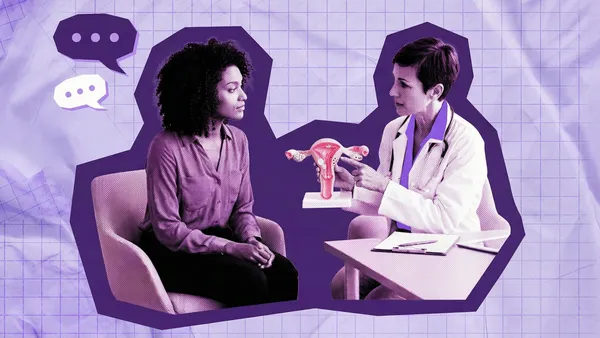
If you had a baby in your late-30s or early-40s, someone has probably offered you the silver lining: at least you'll hit menopause later. Maybe it was a friend. Maybe it was a nurse at your 20-week scan. The theory is that if you don't ovulate while you're pregnant, you're saving eggs, so your body has more runway at the other end. In a Rescripted survey of 234 women, 27% said they assumed this to be true.
But while it’s a nice idea, the research doesn't quite back it up (though it doesn't completely knock it down either). And the question it can actually answer isn't how old you were at your last baby; it’s how many babies you’ve had. Let’s dive in.
Does having kids delay menopause?
A little bit, on average. Women who have given birth do tend to reach menopause somewhat later than women who haven't, and that pattern shows up in some very large studies. But the difference is small, and it’s measured in months, not years. The gap stops growing after two or three kids, and the "saved eggs" explanation mentioned earlier doesn't hold up.
What's actually behind the pattern is still an open question. Researchers have theories, but no solid answer.
So this isn't something to plan a pregnancy around. It’s more of a question about how your body works.
What the research found
The biggest study on this comes from Norway. Gottschalk and colleagues, writing in Human Reproduction in 2022, looked at 310,147 women. Women with no children reached menopause at an average age of 50.6, while women with three children reached it at 51.4. That's a gap of less than a year, and it's the widest gap in the study.
Then the pattern stops. Women with four, five, or seven-plus children didn't reach menopause any later than women with three.
A Canadian study found the same pattern. Scime and colleagues, in the American Journal of Epidemiology in 2024, followed 23,728 women in Alberta's Tomorrow Project from 2000 to 2022. Women with zero or one birth were more likely to reach natural menopause before 50 than women with two. Women with three or more looked the same as women with two.
In the U.S., an analysis of more than 108,000 women in the Nurses' Health Study II (Langton and colleagues, JAMA Network Open, 2020) looked specifically at early menopause, meaning before 45. Each additional birth was linked to lower risk, up to about three.
All three studies are observational. They show that two things travel together; they can't show that one causes the other.
What about breastfeeding?
Same story. In the Nurses' Health Study II, breastfeeding was linked to a lower risk of early menopause, and the link was strongest for women who exclusively breastfed for seven to 12 months. Breastfeeding suppresses ovulation, which is why it usually gets folded into the saved-eggs theory. But this is still an association, not proof, and the saved-eggs theory has a bigger problem.
Why "saving eggs" doesn't add up
The numbers here are genuinely wild. A baby girl is born with roughly 1 to 2 million follicles, the tiny structures that hold immature eggs. By puberty, she's down to about 300,000 to 400,000. Over her whole reproductive life, only about 400 to 500 will ever be ovulated.
The rest are lost through a process called atresia, a steady background die-off that accounts for about 99% of all follicle loss. Ovulation barely registers by comparison. And atresia largely keeps going whether you're pregnant, breastfeeding, or on the pill.
Nine months of pregnancy skips about nine ovulations. During those same nine months, far more follicles are lost to atresia. Skipping a few ovulations is like saving a few drops of water while the bathtub drains.
Menopause arrives when fewer than about 1,000 follicles are left, a threshold described by Faddy and colleagues in Human Reproduction in 1992. So timing depends on how fast the whole pool drains, not on how many eggs you ovulated along the way.
The Norwegian researchers made the same point with their own data. If pregnancy really banked eggs, women with seven children should hit menopause latest, but they didn't.
So what explains the link?
One theory is that the arrow points the other way. If your ovaries are running on a faster clock, you might have a harder time getting pregnant and also reach menopause sooner.
Questions Women Are Asking
The Norwegian authors raised this possibility, but when the Canadian team tested it by setting aside women with a history of infertility, the link between having fewer children and earlier natural menopause mostly held. They suspect something more complicated is going on, some mix of the biological and social effects of having kids that no one has pinned down yet.
If you don't have children, by choice or not, none of this is a verdict on your body. These are averages across hundreds of thousands of women, and the gaps are measured in months.
What actually determines when you reach menopause
Genetics, mostly. Studies of twins and families put the heritability of menopause timing at roughly 44% to 65%, and many of the genes identified so far help cells repair damaged DNA. That makes sense. Your ovaries are handling cellular wear and tear for decades, and how well your cells patch it up affects how long the follicle pool lasts.
The short answer: your mom's and sisters' timing is the best rough guide you have, although it's not a guarantee.
A few other things matter, too. Smoking is the best-established one you can change, and it's linked to earlier menopause. Surgery to remove both ovaries causes menopause right away, at any age. Chemotherapy and pelvic radiation can speed up follicle loss. Some autoimmune conditions are linked to earlier menopause, too.
In the U.S., the average age of natural menopause is around 51, with a wide normal range. About 1% of women have primary ovarian insufficiency, when the ovaries largely stop working before 40.
Can you find out when yours will happen?
Not with any real precision, no matter what a test's packaging says — in fact, there's no blood test or hormone panel that can predict the date your period will stop for good.
AMH (anti-Müllerian hormone) is a marker of ovarian reserve, or how many eggs you have left right now, and it does drop in the years before menopause. But AMH is not a marker for menopause timing, and it shouldn't be read that way. An AMH result is a snapshot; it can only tell you where you are right now.
If you and your provider want to check whether menopause is already underway, FSH (follicle-stimulating hormone) and estradiol (E2) are the hormones typically used for that — not to predict when it will happen, but to help confirm that it’s happening. FSH tends to rise, and estradiol tends to fall as the ovaries wind down, so the two together can support a diagnosis in someone who's already having symptoms.

Direct-to-consumer hormone tests sold as menopause or fertility predictors oversell what a single blood draw can do.
What's more useful is your family history, plus paying attention to how your own cycle changes over time. If your periods start coming closer together, getting more irregular, or getting heavier or lighter, that's worth writing down and bringing to your provider.
What this means for you
Nobody should time a pregnancy around menopause. Even if the link turned out to be fully causal, the difference (once again) is months.
If you're thinking about when to try for a baby, the more useful conversation is with a provider, about your own ovarian reserve and your own goals.
If early menopause runs in your family, bring it up sooner rather than later, especially if you want kids. Family history won't give you a date, but it can change when you start having certain conversations.
And if menopause has never once crossed your mind while thinking about kids, you're in good company. Among women aged 35 to 44 in our survey, 24% said they'd never connected the two at all.
The bottom line
Women who've had children reach menopause a little later on average. The effect tops out around two or three kids, and it's not because pregnancy banks eggs. Why it happens is still being worked out. As for the silver lining about a late baby: the research hasn't really tested it, and the egg math says not to count on it.
What's clearer is that your ovarian clock runs mostly on genetics. So if you want a better guess at your own timing than any study can give you, ask your mom. Then ask your older sisters.