


Kristyn Hodgdon
Everything you’re feeling, but didn’t know how to say.

What I Wish I Asked My OB Before My 10-Week Appointment

When I was around ten weeks pregnant with my twins, I sat in my OB's waiting room with absolutely no idea what I was supposed to ask. I had a notebook. I had anxiety. I had a list that was mostly logistical — is deli meat really off-limits, can I still take Pilates — and zero real questions about genetic testing. Not because I didn't care, but because I didn't know what I didn't know.
What nobody had told me: there were two tests I could have asked for by name.
The first is the Prequel® Prenatal screen, a noninvasive prenatal screen from Myriad® Genetics. It's a simple blood draw, available as early as eight weeks, that screens for chromosomal conditions like Down syndrome. It delivers results to 99.9% of patients, including those with twin pregnancies and high BMI. With two babies and no PGT-tested embryos, knowing what I was actually dealing with would have meant everything.
The second is the Foresight® Carrier screen, which tells you whether you carry an inherited condition you could pass to your baby. It screens up to 274 genes across serious, inherited conditions, with a detection rate of 99% for the majority of conditions across ethnicities. Most of us are carriers of something without knowing it — the question is whether your partner is too.
Both screens are from Myriad Genetics, both can be ordered together, and both are the kind of thing you want to know about before you're sitting in that waiting room (not after).
Walking in informed isn't the same as walking in without fear, but it's closer to walking in ready.


We're All as Tired as Post Malone Right Now (per the CDC)
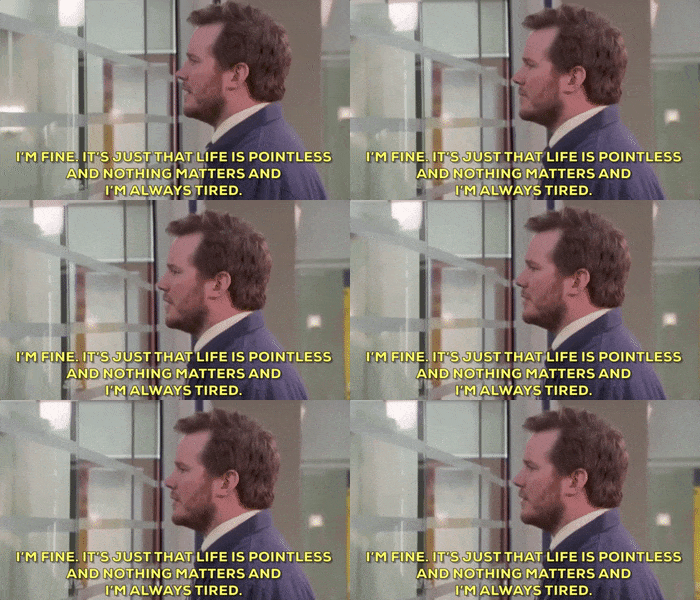
I was driving to get coffee with my husband the other day when he turned to me, completely out of nowhere, and said, "Why am I always tired?"
I almost laughed, because same (Post Malone has that tattooed on his face for a reason), but he picked a good time to ask. The CDC just put out a report on exactly this: 71.5% of U.S. adults said they'd felt fatigued at some point in the last three months, and 16.6% said it was most days, or every day. Not tired-tired. The kind that doesn't go away with sleep. And for almost 40% of the people in that group, it wasn't mild; it was a lot. I used to think more sleep would fix it, but apparently that's not really how it works (even if you use a silk pillowcase).
The same report found it's actually worse for younger adults than older ones: 19.5% of 18-to-34-year-olds said they're frequently fatigued, compared to under 13% of people over 65.
Women are also more likely than men to land in that most-days-or-every-day group — 20% of us, versus 13% of men. Which means, statistically, I'm the one who's supposed to be asking that question in this car, not him.
Except he's actually good at this part: we split the three kids, the doctor's appointments, the permission slips, who has practice when, pretty evenly. If he's doing his half and he's still that tired, something else might be going on.
So instead of making a joke about it, I handed him my coffee and told him to go book a physical.
I Cried at Wicked and It Wasn't About the Witches

I have this problem in motherhood, and it's called grieving-the-moment-while-it's-still-happening.
I'm not sure if other moms can relate, but last weekend I took my daughter to see Wicked on Broadway, and I felt myself tearing up mid-show — not just because of Glinda and Elphaba's unlikely friendship, or the goat professor who could no longer speak (baa), but because I knew I would only get to live in this memory this one time.
You're probably thinking, "obviously, Kristyn, that's how life works," and I know that. But motherhood is bittersweet in so many ways: you want to watch them grow up and freeze time, sometimes in the same minute, let alone the same hour or the same day.
On one hand, it's so much more fun now that she's almost eight and can run through Times Square with me to catch the next train home. But she's also a little more independent, and a little more sure of herself every single time we're out together.
Having multiple kids also makes me feel like there isn't enough time in the world to give each of them the individual attention they probably deserve, so there's that guilt, too. I haven't figured out how to fix it, I just feel it.
There's actually a word for this: anticipatory nostalgia, or missing a moment before it's even over. A psychologist who studied it found it's more common in women than men, which is shocking, I know.
I guess as moms we can't win, but it's also what makes days like this one worth every penny (and then some).
I Haven't Read The Love Hypothesis Yet (But I Know How It Ends)

I haven't read The Love Hypothesis yet (I know, I know), but now that the movie with Lili Reinhart is streaming on Prime Video, it's at the very top of my list. I love a good rom-com, and I'll read pretty much anything Emily Henry, Carley Fortune, or Jasmine Guillory puts out.
So when I looked into whether romance novels are actually good for you, I was a little annoyed to find there isn't much research on romance on its own — which, TBH, doesn't surprise me for a genre mostly written and read by women. There is plenty on reading in general, though. In one randomized trial of nearly 1,000 people, 42% of those who read a book in bed for a week said their sleep improved, compared to 28% of those who didn't.
I believe it, but that's not really why I read romance. I already sleep like a rock (my Oura ring can vouch for me), and a good meet-cute has kept me up late more than a few times because two childhood best friends still hadn't admitted how they felt about each other. Add in faeries and a High Lord or two, and the ACOTAR series nearly hijacked an entire summer.
Clearly, patience has never been one of my virtues. But a juicy romance gives you anticipation and predictability at the same time, which is oddly comforting. You know from the very first page that they end up together, and the only question is how long it takes them to figure it out.
From Pride & Prejudice to a random novel about a couple whose relationship starts as a cover story (she's his bodyguard, he has a corgi-breeding stalker, don't ask), it's the only kind of waiting I've ever enjoyed.
The Urgent Care Trip Your UTI Doesn't Need

If you've ever felt the very specific discomfort of having to pee thirty seconds after you just went, welcome to Girlhood. The burning, the urgency, the sense that something is off before you've even confirmed it — you don't need a lab to tell you what your body already knows.
And you're probably not wrong to want to skip the whole detour. For most women with an uncomplicated UTI, a urine culture isn't actually required before doctors start treatment. Current guidelines list fosfomycin, nitrofurantoin, and trimethoprim/sulfamethoxazole, all standard antibiotics, as first-line options based on symptoms alone. And yet, the default is still: drag yourself somewhere, sit in a waiting room, describe the same three symptoms to a stranger, and walk out with antibiotics you basically diagnosed yourself.
What changes the experience isn't more testing. It's having someone who can just listen, hear "it burns and I've been here before," and take that as sufficient information, not the start of a workup. Apios Health treats straightforward UTIs from home over text. No copay for a visit you didn't need, no explaining yourself twice. And if something's actually more complicated, like recurrent infections, pelvic floor stuff, or an STI you'd swear was a UTI, they loop in a specialist.
So much of women's healthcare still runs on the assumption that we need to prove we're really in pain before anyone does anything about it. A UTI isn't a mystery; it just requires someone willing to believe you the first time.
Pregnant "In No Time" (Narrator: She Was Not)

There's a big part of the fertility journey that doesn't get enough credit, and spoiler alert: it's everything that happens before IVF.
When I first got diagnosed with PCOS (now PMOS, although I still can't get used to saying it), my fertility specialist at the time told me I'd "just need some Clomid or Letrozole" — aka ovulation induction meds — to kickstart my cycle, and I'd be pregnant "in no time." Fast forward a year, and I was starting IVF, wondering why the hell it took her so long to suggest the one thing that actually ended up working.
IVF isn't a guarantee, and I know that better than most now. But the steps that usually come before it — ovulation induction, timed intercourse, IUI — rarely get talked about with any real detail. My body, for one, over-responded to Clomid (think: multiple mature follicles, high risk of triplets, etc.), and under-responded to Letrozole. My IUI cycles were often grueling, with dozens of monitoring appointments before even getting to the trigger shot and IUI, all for odds that hover somewhere between 10 and 20% per medicated cycle.
After months and months of hope and disappointment, IVF is what ended up working for us, but that's just my story, and I know it doesn't look the same for everyone.
All of this is to say, we want to keep highlighting those experiences. If you have a Letrozole success story, or an IUI cycle you're proud of, I'd love to hear from you: kristyn@rescripted.com.
Somewhere, right now, someone's IUI is about to be the one that finally works, and I want her to have hope while she's still in it.
Being a Sports Mom Is Not for the Weak

I was an athlete my whole life — softball, basketball, cheerleading, more softball, with a theater-kid detour in between. Most of my best friends came out of team sports, the kind of friendships you only get from being sweaty and fourteen together. So you'd think I'd be built for this next phase. Instead, I'm completely overwhelmed by it.
Part of it is having twins. Up until now, my boy/girl duo has either played on the same team or stuck to rec and intramural: low stakes, same schedule, done. Third grade, apparently, is where that ends. They're each on separate travel soccer teams now, with two practices a week per kid and a game on Saturdays, which sounds manageable until you're actually in it.
This past Saturday we had a game at 11, another at 2:45, and our neighborhood block party at 4. I scrubbed my bathroom in the ninety-minute gap between fields, half-watching my toddler, half-wondering why my kids had to turn out athletic when I already have a full-time job and an ADHD brain that was not built for this many calendar invites.
And still: I watched my son score his first goal. I watched my daughter find her footing on the turf, literally, and get that little flash of I can do this on her face. I love the teams they landed on, and with the help of our village, I think we're actually going to be okay.
There's a version of this where I pull back, where two sports across two kids is too much. But I keep coming back to the same gut check I use for everything else as a mom: not what looks balanced on paper, just whether they're lit up when I pick them up. So far, they are.
The Case for Starting a Book Club

My friends like to make fun of me because many of my relationships over the last decade or so have started with book clubs. Here's how it goes: I form a book club, we meet a couple of times, people connect, books are read (and not read), wine is had, and friendships grow. Some stick, some don't. But that's not the point. The point is connection... and interesting conversation.
I thought about this while reading The Atlantic's recent cover story on the decline of reading in America. Fewer than half of adults reported reading a book in 2022, and just 20 percent of adults account for more than 80 percent of all books read in a year (read that again). The piece calls this shift postliterate: not illiterate, just unable to sit with something long enough to think it through.
What hit home for me wasn't the average attention span on a screen shrinking to 47 seconds, although that did make me want to throw my phone in the ocean. It was that reading forces a slowness nothing else does. You can't scroll through a novel. You sit in someone else's head for a few hundred pages, and that is its own act of defiance.
The real magic happens in discussing it, though. A book club isn't really about the book. It's an excuse to sit across from other women and talk — about the plot twist, sure, but also whatever's actually going on that week, like the diagnosis someone's still processing, or the kid they're worried about but haven't brought up yet.
So start the club. Half of them won't read the book, but most of them will show up for each other.
Gabrielle Union Talks Hot Flashes, and I Am Taking Notes
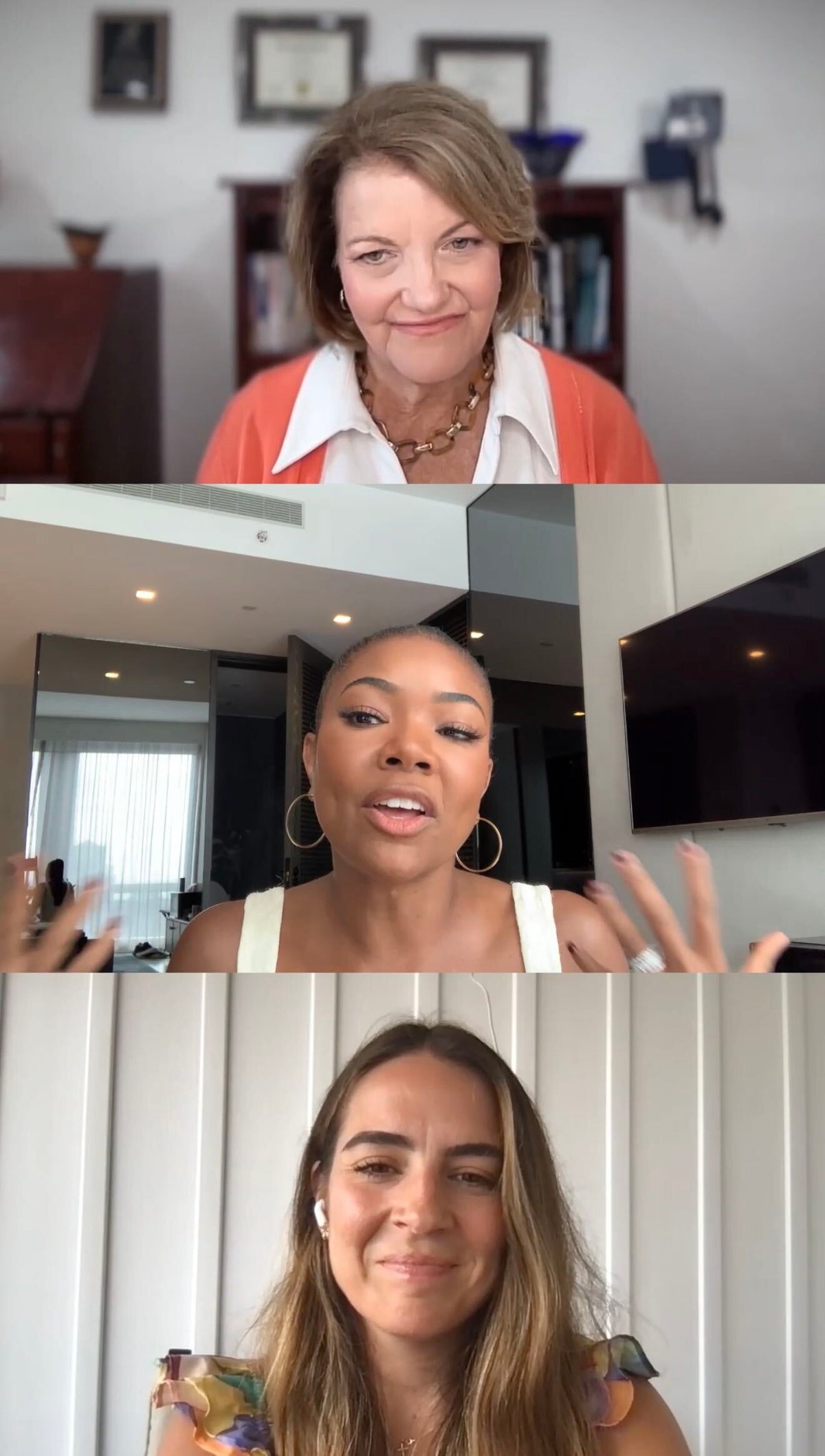
I recently had the pleasure of sitting down with Gabrielle Union-Wade, which, as someone who was a high school cheerleader in the early 2000s, was a major fangirl moment for me. But perhaps even moreso than her role in Bring It On, is my admiration for her unflinching openness about fertility, surrogacy, motherhood, and now, menopause.
She told me about shooting a sex scene with a costar twenty-plus years younger than her when a hot flash hit so hard she was instantly drenched. The crew thought she looked scared, but she wasn't; she'd done thousands of these scenes. She just felt herself shrinking, and Gabrielle Union does not shrink.
She'd learned she was perimenopausal in her late thirties, from a routine blood panel during a fertility workup, years before a single hot flash showed up. Then in her mid-forties, they arrived, and not the fleeting kind the name implies.
Nurse Barb, a nurse practitioner and certified menopause specialist on the call, said residents get one or two total hours of menopause education in training. I can't even get through a lasagna recipe in an hour.
About 1.3 million women enter menopause every year in the U.S., and hot flashes can stick around for seven years, some well over a decade. Researchers call those women "super flashers," which sounds like a superhero and decidedly is not.
After calling her doctor and saying, essentially, this cannot be life, Gabrielle found something that worked. But when I asked what she'd gained, she skipped past the treatment and went straight to the community: other women comparing notes, realizing they weren't the only ones white-knuckling it through a meeting, or in her case, a scene.
She didn't need a fix so much as she needed company, and I'd say the same goes for most of us.
Watch the full conversation on YouTube here.
Sara Bareilles Wrote the Infertility Song I Needed at 28

My co-founder Abby sent me a clip of Sara Bareilles talking about her new song, and it instantly brought tears to my eyes.
I've always said that sitting in the waiting room of a fertility clinic at 28 years young, where everyone was going through a similar experience and yet no one was making eye contact, is what inspired me to start Rescripted.
There's no lonelier feeling than being in a room full of people dealing with the same heartbreaking experience but too ashamed to speak about it, or even look at one another.
That's exactly what Sara captures in "Ladies in a Line," off her new album Good Grief. She's been trying to have a baby for three years, and in a recent interview she said something that deeply resonated: she'd found plenty of women talking about how hard it was once they finally had a healthy baby in their arms, but almost nobody talking from inside the messy middle.
This song sits in that middle. The needles, the waiting, the grief of starting later than planned, a running list of names for a baby who hasn't arrived. She describes the process like swimming in water someone else is directing, with no idea when you'll be allowed to stop. I did several rounds of IVF, so none of that is hard to imagine.
What gets me is that she wrote this before knowing how her own story ends, and it gives me chills thinking how many women will feel less alone because of it.
A 2024 survey found that 39% of women trying to conceive underestimated how lonely it would feel, which makes sense, considering I still think about my own waiting room experience. It's nice to finally have the song none of us could sing out loud back then.