

Sponsored by Bobbie
As a board-certified emergency medicine physician and the Chief Clinical Officer of Apios Health, I answer questions about infant feeding weekly... And as a mom who supplemented with formula, I've lived the other side of that conversation too — the questions, the label comparisons, the deep need to make the "right" choice.
The decision feels enormous because it's personal, and because the information out there can be a lot.
As a doctor, here's what I actually looked for when choosing a formula — and why I chose Bobbie for my own baby.
How to choose baby formula. What do I look at, as a physician?
First, there's no "wrong" formula. Every infant formula sold in the U.S. has to meet strict FDA (Food and Drug Administration) nutritional and safety requirements. If it's on the shelf, it meets an important baseline.
Fed is best — full stop. If breastfeeding didn't work out the way you planned, or you're combo-feeding and feeling conflicted, please hear me: You're not failing your baby.
The meaningful differences between formulas come down to a handful of things:
Carbohydrate source
Protein structure
Fat blend
DHA levels (docosahexaenoic acid, a crucial omega-3 fatty acid)
The brand's testing and transparency standards
Those are the criteria I used as both a physician and a parent.
What baby formula is closest to breast milk?
No infant formula is identical to breast milk. Instead, parents can compare specific characteristics, such as carbohydrate source, protein composition, fat sources, and nutrients such as DHA.
The markers I look for, as a doctor, are lactose as the primary carbohydrate, a whey-forward protein ratio (60:40 whey-to-casein), a fat blend that includes whole milk fat, and DHA at meaningful levels.
Bobbie Organic Whole Milk Formula is modeled after breast milk in each of those areas. It's made with 100% lactose — the same primary carbohydrate found in breast milk — which delivers naturally occurring prebiotic properties that support digestion, energy, and growth.
Bobbie's protein ratio is whey-dominant. And because it's whole milk-based, it contains more naturally occurring milk fats and fewer added oils to support easy digestion and healthy stool texture.
What ingredients should I look for in baby formula — and avoid?
Here's what I want to see on an infant formula label:
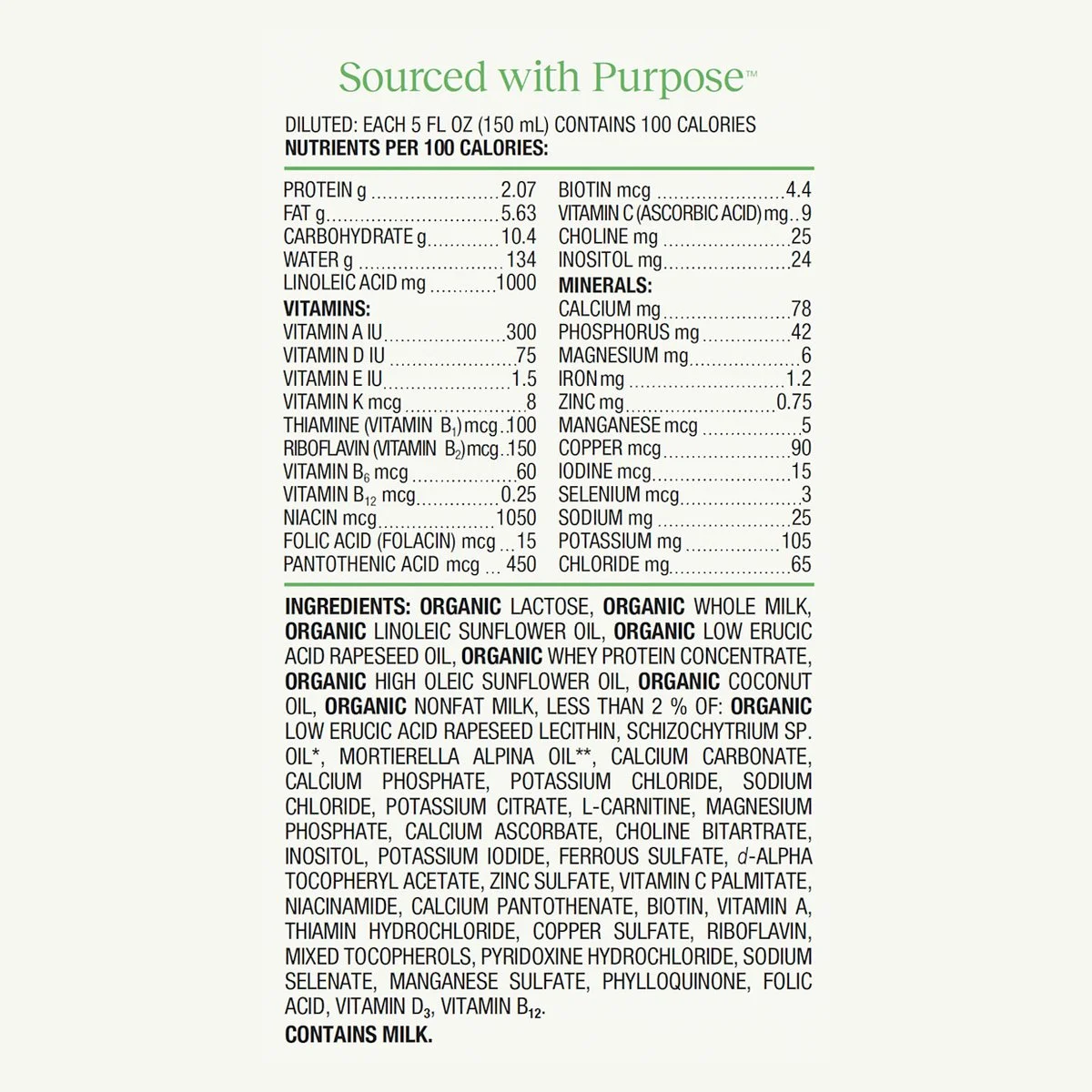
Essential fatty acids: Bobbie's proprietary organic fat blend is packed with omega-3 and omega-6 fatty acids to support healthy growth from day one.
DHA at EU-required levels: Bobbie provides 20mg per 100kcal (milligrams per calorie) in each serving, meeting the European Union's (EU) mandatory DHA threshold. The U.S. doesn't require DHA in infant formula at all, so many domestic formulas include far less.
Lactose as the sole carbohydrate: Just lactose for healthy infants without allergies.
Iron at evidence-based levels: Bobbie delivers 1.2mg per 100kcal serving, meeting both U.S. and EU guidelines.
Choline: This essential nutrient is critical for brain development. Bobbie includes it at levels that meet both U.S. and EU standards.
DHA, choline, and iron are carefully calibrated in Bobbie's formula to support cognitive development and a strong immune system from day one.
How do I know a baby formula is safe?
Safety goes beyond what's on the ingredient list. It's about how the formula's made, where it's manufactured, how rigorously it's tested, and, critically, whether the brand is transparent about those results. This is what I focused on.
Bobbie is FDA-registered and manufactured in the U.S. from globally sourced ingredients, which means fewer supply-chain variables and a shorter route to your baby's bottle. Every batch goes through over 2,000 quality checks before it ships.
The certifications matter, too:
Dual-certified organic and third-party tested: Bobbie has both USDA (United States Department of Agriculture) and EU organic certifications. It's independently tested for contaminants, including rigorous heavy metals testing.
Clean Label Project Purity Award: A third-party certification that tests for 400+ toxins and contaminants (solvents, parabens, BPA)—including heavy metals.
Clean Label Project Certified Pesticide-Free: Tests for over 300 of the most common pesticides (including glyphosate).
Monthly Light Labs testing: This independent third-party lab screens for over 550 additional toxins on all Bobbie formulas, every month, with results published on Bobbie's website down to parts-per-billion accuracy.
Consumer Reports "Top Choice": Awarded across all four Bobbie formulas.
Transparency doesn't stop with these tests and certifications. Bobbie's Transparency Tracker lets you look up the safety results for your exact can by batch number. I've done it. There's something deeply reassuring about scanning your can and seeing the test results right there on your phone.
That's what end-to-end safety looks like.
 My baby seems fussy or gassy — do I need a lactose-free or "gentle" formula?
Lactose intolerance is rare in full-term infants. When a baby is fussy or gassy, the usual culprit is protein size, not lactose.
This distinction is good for parents to know because the terms "dairy-free," "lactose-free," and "gentle" aren't interchangeable.
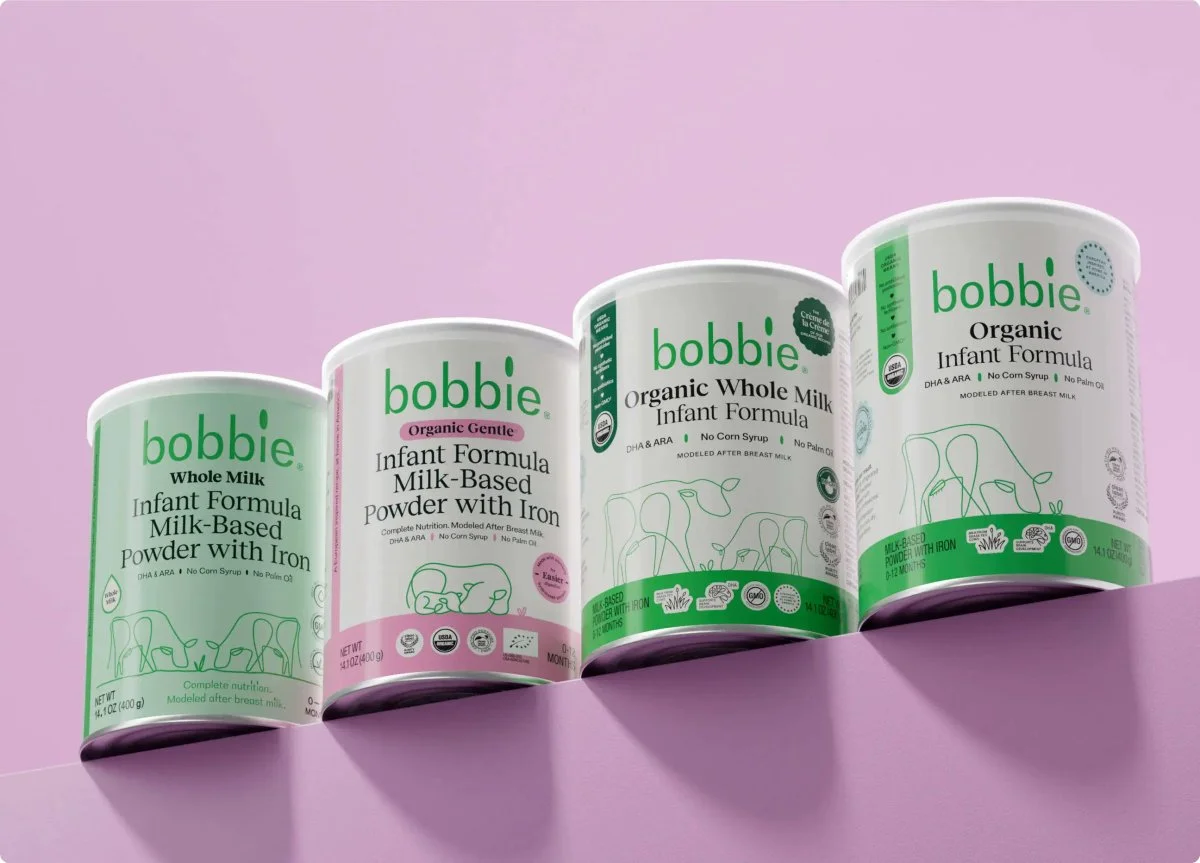
Most "gentle" formulas in the U.S. strip out lactose and replace it with corn syrup solids or maltodextrin, which is sometimes needed for infants with true lactose sensitivity. Bobbie Organic Gentle takes a different approach: It's the only USDA Organic gentle formula made with 100% lactose for carbohydrates. It's clinically crafted with partially hydrolyzed whey proteins — smaller, broken-down proteins — to ease fussiness, gas, and crying while keeping lactose as the carbohydrate source.
If your baby is showing signs of discomfort with formula, consult with your pediatrician before making any formula changes.
Frequently asked questions about choosing baby formula
Can I switch formulas if my baby doesn't tolerate the first one?
Yes. Talk to your pediatrician first, but switching formulas is common and generally safe. Most babies adjust within a few days. If fussiness or digestive discomfort is the issue, some parents try a gentle formula with partially hydrolyzed proteins (like Bobbie Organic Gentle).
Does Bobbie work for combo-feeding?
It does. Bobbie's whey-dominant protein ratio and lactose base can complement breast milk, which can make transitions between breast and bottle smoother. Many of my patients combo-feed successfully with Bobbie.
Where is Bobbie formula made?
Bobbie is made in the United States. Domestic production means a formula takes the shortest possible route to your baby's bottle.
See how Bobbie stacks up against other infant formula brands.
Bobbie Organic Whole Milk | Kendamil Organic Whole Milk | Similac Irish Farms | Enfamil Optimum | Little Spoon Organic Whole Milk | Munchkin With Organic Whole Milk | |
USDA Organic | Yes | Yes | No | No | Yes | No |
EU Organic* | Yes | Yes | No | No | Yes | No |
Clean Label Project certified | Yes | Yes | No | No | Yes | Yes |
Contains MFGM** | Yes | Yes | No | Yes | Yes | No |
No palm olein oil | Yes | Yes | Yes | No | Yes | Yes |
Meets U.S. & E.U. iron guidelines | Yes | Yes | No | No | Yes | No |
Subscription available | Yes | No | Yes | Yes | Yes | Yes |
Manufactured in the U.S. | Yes | No | No | Yes | Yes | No |
Mom founded and led | Yes | No | No | No | No | No |
Available from two or more retailers | Yes | Yes | Yes | Yes | No | No |
Third-party heavy metal testing published | Yes (monthly, LightLabs) | No | No | Yes | Yes | No |
*Certified organic to USDA standards. Recognition by the EU is via the US/EU Organic Equivalency Arrangement
**Naturally occurring MFGM from whole milk, or from whey protein concentrate
Sources: Product labels and brand websites; Consumer Reports infant formula testing and ratings; CDC guidance on choosing an infant formula; FDA infant formula list.
Is whole milk formula better than skim milk formula?
Not necessarily; both can provide complete nutrition for your baby. What I like about whole milk formula is that it contains naturally occurring milk fat, rather than relying exclusively on added oils for fat. Bobbie Organic Whole Milk uses whole milk as its first ingredient and combines naturally occurring milk fat with an organic fat blend to provide the essential fatty acids babies need.
Does baby formula need DHA?
DHA is a crucial omega-3 fatty acid that supports brain and eye development. Interestingly, DHA isn't required in U.S. infant formula, although it is required in the European Union. Bobbie includes DHA at 20mg per 100kcal, meeting the EU's mandatory DHA threshold.
Is organic baby formula better?
Organic doesn't automatically mean a formula is better for every baby. All infant formulas sold in the U.S. have to meet FDA nutritional and safety requirements. For parents who do prefer organic, Bobbie Organic Whole Milk is certified organic to USDA standards and also meets EU organic requirements.
I chose Bobbie because it checks the boxes I look for as both a parent and a physician: 100% lactose as the primary carb, EU-level DHA, dual organic certification, none of the ingredients I'd rather not feed my baby, and transparent formula testing and batch tracking (in a world of tons of formula recalls). Not to mention the fact that this formula is easy to find — I can pick it up at many stores or while traveling.