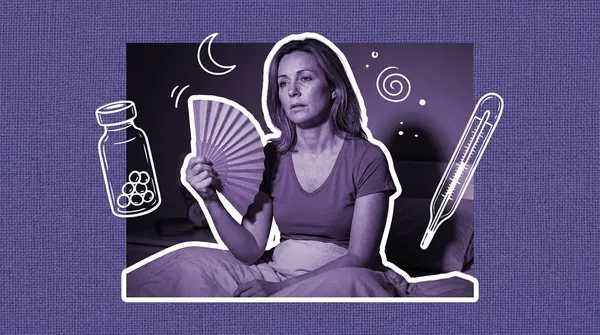
If you've been Googling "natural menopause relief" at 2 a.m. while lying in sweat-soaked sheets, you've probably stumbled across homeopathy. Maybe you've seen little vials of tiny white pellets at your health food store or heard a friend swear by something called Sepia.
But what is homeopathic medicine, and could it help with the hot flashes, mood swings, and sleepless nights that have become your unwelcome new normal? We'll walk you through what it is, why women reach for it, and what the research actually shows — which, spoiler alert, is thinner than the online enthusiasm suggests.
First things first: what is homeopathic medicine?
Homeopathy is a system of medicine developed in the late 1700s by a German physician named Samuel Hahnemann. It's built on a principle called "like cures like," the idea that a substance capable of causing symptoms in a healthy person can, in highly diluted form, treat similar symptoms in someone who is unwell. Homeopathy is sometimes compared to the logic behind vaccines, but the two work in opposite directions: vaccines use a measurable dose to trigger a documented immune response, while homeopathy claims the opposite, that diluting a substance away makes it stronger.
The starting substances span the natural world — a plant like arnica, a mineral like sulphur, or, in Sepia's case, cuttlefish ink — repeatedly diluted in water or alcohol until, at the highest potencies, no molecule of the original substance is likely to remain. In homeopathic thinking, the more diluted a substance is, the more potent it becomes. Conventional science struggles with this concept because at high dilutions, very little, or none, of the original substance remains.
What’s worth noting is that homeopathy treats the whole person. It doesn't just look at your hot flashes in isolation. A homeopath considers your physical symptoms, emotional state, sleep patterns, temperament, even whether you prefer warm rooms or cold ones. For something as multifaceted as menopause, that holistic lens has understandable appeal.
Homeopathic vs. naturopathic: what's the difference?
Homeopathy is a specific system of medicine using highly diluted remedies, and its practitioners are called homeopaths.
Naturopathy is a broader philosophy of natural medicine that may include homeopathy, but also encompasses herbal medicine, nutrition, lifestyle counseling, and in some states and countries, even prescription medications.
The simple way to remember it is that all homeopaths practice homeopathy, but not all naturopaths do. A naturopathic doctor (ND) might offer you a wider toolkit for menopause. A classical homeopath will zero in on the specific remedy that matches your unique symptom picture.
Also, licensing and regulation vary widely depending on where you live. Some states and countries regulate homeopathic practitioners; others don't. This doesn't mean you can't find excellent practitioners — it just means doing a bit of homework before booking that first appointment.
Why women are turning to homeopathic menopause relief
While hormone replacement therapy (HRT) was once considered controversial after a 2002 study raised cancer and heart-disease fears, newer analysis of that same data has refuted those concerns — and, paired with an FDA reversal on its warning labels, has restored HRT to its earlier status as the gold standard for many menopausal symptoms.
But HRT isn't right for everyone. Some women have contraindications like a history of certain cancers or blood clots, and others simply prefer to explore non-hormonal options first.
That's where homeopathy's appeal comes in. It's individualized, generally considered low-risk for side effects, and it doesn't just treat hot flashes. It considers the anxiety, the grief, the irritability, and the feeling that your body has become a stranger.
Rescripted survey data suggests mood swings, hot flashes, sleep disturbances, and bloating are the symptoms readers most want relief from, and homeopathy claims to address all of these through a single, personalized approach.
While the evidence base is mixed, and we're not going to pretend otherwise, millions of women worldwide have reported meaningful relief from homeopathic remedies, and lived experience deserves a seat at the table even if the science is still catching up.
What is the best homeopathic remedy for menopause? (It depends on you)
When it comes to homeopathy, there is no single "best" remedy. The right remedy is matched to your unique symptom picture, your temperament, and even your emotional state. That said, certain remedies come up again and again in menopause care. Here's a look at the most commonly used ones.
Sepia — for the woman who is running on empty
If you feel utterly drained, emotionally flat, and secretly wish everyone in your house would just leave you alone for five minutes, Sepia might be worth exploring. In homeopathic practice, Sepia is traditionally indicated for exhaustion, irritability, indifference toward loved ones (even when you know you love them), hot flashes with sweating, hair thinning, and a general sense of being completely depleted.
A common self-prescribed potency is 30C, available at many health food stores. But for deeper, longer-standing symptoms, working with a practitioner yields much better results.
Lachesis — for the woman who is turned all the way up
Everything feels amplified. Your hot flashes surge upward like a wave of lava. You can't stand anything tight around your neck or waist. You're talkative, passionate, maybe a little jealous, and your symptoms tend to be worse after sleep (hello, waking up drenched and furious). Lachesis speaks to women whose menopausal experience feels volcanic, intense, unpredictable, and hard to contain.
Pulsatilla — for the woman who just needs a good cry
If menopause has left you feeling weepy, emotionally raw, and craving comfort, Pulsatilla might resonate. This remedy matches a profile of changeable moods, a need for fresh air, feeling worse in warm or stuffy rooms, and hot flashes that paradoxically come with chills. It's for the woman who feels emotionally open and vulnerable and needs that to be honored, not dismissed.
Glonoinum — for the hot flash that feels like your head might explode
Some hot flashes are manageable. And then there are the ones that hit like a freight train: sudden, intense, with a throbbing headache and a face that turns beet red. In homeopathic practice, Glonoinum is traditionally used for these severe, sudden-onset flashes, especially when they come with a feeling of congestion or pressure in the head.
Questions Women Are Asking
Ignatia — for the woman grieving her former self
This one deserves special attention because it speaks to something menopause culture rarely addresses: grief. Grief for your younger body, your fertility, your old identity, the version of you that could sleep through the night without waking in a pool of sweat. In homeopathic practice, Ignatia is traditionally indicated for emotional sensitivity, sighing, contradictory symptoms, anxiety, and mood swings that feel disproportionate to the trigger.
The years of shifting hormones leading up to menopause — perimenopause — are the real transition, and feeling sad about what's changing doesn't mean something is wrong with you. It means you're human.
A note on constitutional vs. acute prescribing
In homeopathy, there are two main approaches. Acute prescribing means self-selecting a remedy for a specific, short-term symptom, like taking Glonoinum for an intense hot flash.
Constitutional prescribing involves working with a qualified homeopath who takes an in-depth case history (often 60-90 minutes) and selects a remedy based on your entire physical, emotional, and mental picture. For significant or long-standing menopausal symptoms, constitutional treatment is generally considered more effective.
Homeopathic medicine for menopause: what does the science say?
You'll often see a 2024 review in the International Journal of High Dilution Research cited as evidence that homeopathy works for menopause. It's peer-reviewed, published by a journal connected to homeopathy research and advocacy groups, and it rounds up nine studies said to support homeopathy's efficacy for hot flashes, mood swings, and sleep disturbances. Look closer, though, and the evidence is thinner than it sounds.
One of the nine, the HOMDEP-MENOP trial, was withdrawn by PLOS ONE in 2020 after editors found the protocol wasn't reproducible and the design couldn't rule out placebo. Three more weren't controlled studies at all: a patient satisfaction survey with no treatment arm, a feasibility pilot, and an unpublished dissertation. Another failed on all three of its primary outcomes but was still counted as supporting evidence.
So while homeopathy tends to look promising in observational studies where women report their own improvement, that promise hasn't held up in the controlled trials designed to separate a real effect from placebo. Further, homeopathy is difficult to study using standard double-blind, placebo-controlled trials because the whole system is based on individualized prescribing. Giving every participant in a study the same remedy defeats the purpose of how homeopathy actually works.
And then there's the placebo conversation. Some researchers argue that homeopathy's benefits are largely placebo, but it's also worth noting that the relief women experience is real, regardless of whether the mechanism is fully understood.
Controlled trials haven't shown homeopathic remedies outperforming placebo for menopausal symptoms. That said, the risk is low, the consultation itself is often deeply valuable, and for many women that's worth exploring, as long as it isn't standing in for care that would help more.
Homeopathic treatment for menopause: how to actually get started
Ready to explore? Here's your practical roadmap.

Track your symptoms in detail. Before trying anything, spend a week or two documenting exactly what you're experiencing: when symptoms occur, what makes them better or worse, and how they affect your mood and energy. The more specific your symptom picture, the better matched your remedy will be.
Decide between self-prescribing and seeing a practitioner. For mild, isolated symptoms (occasional hot flashes, for example), a 30C remedy from a health store might be a reasonable starting point. For complex, overlapping, or long-standing symptoms, it may be worth investing in a proper consultation.
Find a qualified homeopath. Look for practitioners certified by organizations like the Council for Homeopathic Certification (CHC) or the North American Society of Homeopaths (NASH). Ask about their training, experience with menopausal patients, and approach to working alongside conventional care.
Set realistic expectations. Homeopathic remedies aren't instant fixes. Many practitioners suggest allowing four to six weeks to assess whether a remedy is working. If there's no improvement, the remedy may need adjusting.
While homeopathy is generally considered safe to use alongside other treatments, including conventional care, it's important to always loop in your OB/GYN or menopause specialist, especially if you're on other medications. And if symptoms are severely impacting your quality of life, homeopathy alone may not be sufficient.
The bigger picture: menopause deserves a full toolkit
Here's what actually moves the needle for menopausal symptoms: strength training, consistent sleep, targeted nutrition, stress management, CBT, and HRT. Once those foundations are in place, homeopathy is a low-risk option to layer on if its individualized, whole-person approach appeals to you.
HRT remains the most evidence-backed option for many women and isn't the villain it was once painted to be. Some women thrive with a combined approach — HRT for the biology, homeopathy or other integrative therapies for the emotional and energetic shifts. As one woman in an online menopause community put it, she tried evening primrose oil, vitamin E, and CBD before finding what worked. Every body responds differently, which is exactly why tracking your own symptoms matters more than any list of what worked for someone else. And plenty of women will tell you nothing worked until they finally went on HRT.
All of those paths are valid. You deserve options, information, and a provider who actually listens, whatever path you choose.
You're the expert on your own body, and that includes this
Menopause is not a medical crisis to be managed. It's a single point in time, but the years of change that lead there and follow it deserve the same curiosity, respect, and care you've brought to every other phase of your health. Whether homeopathy becomes a cornerstone of your approach or something you try and set aside, the most important thing is that you feel empowered to ask questions, push back on one-size-fits-all answers, and pursue what actually works for your body.
Nobody gets to tell you what relief should look like. Not the internet, not your cousin's neighbor who swears by a specific supplement, and not the doctor who dismisses everything that doesn't come in a prescription bottle. Your body, your menopause, your call.